
Crowdfunding has transformed the way startups access capital, offering multiple avenues beyond traditional investors, banks, and venture capital funding options.
In today’s competitive market, startups need not rely solely on personal savings or bank loans to launch innovative products or services successfully. It provides a unique opportunity to validate business ideas while simultaneously raising essential funds from a broad, engaged audience.
What Is Crowdfunding?
Crowdfunding involves raising capital for projects or businesses by collecting small contributions from a large number of people, typically online. This method democratizes finance, allowing entrepreneurs to directly connect with potential supporters, create brand awareness, and gather feedback simultaneously.
It not only provides funding but also allows startups to test the market for product viability, improve concepts based on feedback, and build a loyal customer base before official launch.
Types of Crowdfunding
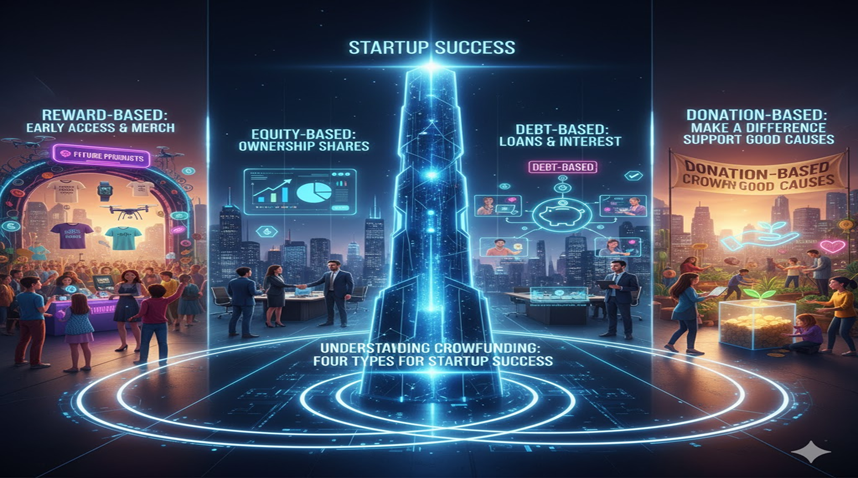
Startups have four main types available, each catering to different business goals, investor expectations, and funding strategies. Understanding these types ensures that entrepreneurs select the best fit for their business stage and growth trajectory.
- Reward-Based Crowdfunding
In reward-based crowdfunding, backers contribute money in exchange for non-financial rewards, such as early access to products, branded merchandise, or special experiences. This type of crowdfunding works well for consumer-focused startups aiming to validate product ideas while attracting initial customers.
Platforms facilitating reward-based campaigns provide tools to manage pledges, communicate with supporters, and deliver rewards efficiently. Successful campaigns generate buzz around products while simultaneously funding production, marketing, and distribution efforts.
By offering rewards that match the funding tier, startups incentivize larger contributions while keeping supporters engaged throughout the campaign. This model encourages creativity in marketing and strengthens community loyalty.
- Equity-Based Crowdfunding
Equity-based crowdfunding allows investors to provide capital in exchange for ownership shares or equity in the startup. This model suits startups with significant growth potential and scalable business models, as it attracts investors interested in long-term returns.
Equity crowdfunding provides access to capital without incurring traditional debt, while simultaneously building a network of invested stakeholders who may contribute business expertise or marketing support. By clearly communicating financial projections and business strategy, startups can attract investors who share their vision.
Moreover, equity crowdfunding can help validate business credibility because investors conduct due diligence before contributing. This approach ensures the startup demonstrates transparency, accountability, and preparedness for future growth challenges.
- Debt-Based Crowdfunding
Debt-based crowdfunding, also called peer-to-peer lending, involves borrowing money from multiple individuals or institutions, which must be repaid with interest over a specified period. This approach suits startups with predictable revenue streams and repayment capacity.
Unlike traditional bank loans, debt crowdfunding platforms often offer faster access to funds, flexible repayment terms, and a wider investor pool. Entrepreneurs must ensure accurate financial planning, as failure to repay could damage credibility and future funding opportunities.
Additionally, debt crowdfunding allows startups to retain full ownership while leveraging community support. By structuring loans strategically, businesses can minimize risk and use the funds to scale operations or invest in critical growth areas.
- Donation-Based Crowdfunding
Donation-based crowdfunding involves collecting funds from individuals who expect no financial return. While most commonly associated with charitable causes or community projects, this approach can support social-impact startups that aim to generate meaningful change alongside profit.
Social entrepreneurs can leverage donation crowdfunding to fund initiatives, raise awareness, and connect with supporters who value mission-driven work. Campaign success depends on storytelling, clear communication of impact, and regular updates to maintain donor engagement.
Although donation-based crowdfunding does not provide financial returns, it can enhance brand reputation, attract volunteers or partners, and establish a community aligned with the company’s vision. This method is often combined with other funding types for balanced growth.
Choosing the Right Crowdfunding Model
Startups must carefully evaluate several factors before selecting a crowdfunding model. First, consider the stage of the business: early-stage ventures often benefit from reward-based crowdfunding, while growth-stage companies may prefer equity or debt models.
Funding goals should also guide the decision. Reward-based campaigns generally raise smaller amounts, making them ideal for product development or initial marketing. In contrast, equity and debt crowdfunding support larger capital requirements for scaling operations or expanding market reach.
Investor expectations are another crucial factor. Equity investors want ownership stakes, debt investors seek interest payments, and reward-based backers expect products, services, or perks. Matching investor expectations with business capabilities ensures smoother campaign execution.
Legal and regulatory considerations must not be overlooked. Different crowdfunding types are subject to varying rules, such as financial disclosures, investor protections, and fundraising limits. Compliance avoids legal penalties and builds trust with contributors.
Alternatives and Complementary Funding
While crowdfunding provides numerous advantages, it should not be the only source of capital. Traditional methods like angel investors, venture capital, and bank loans remain viable options for startups.
Combining crowdfunding with other funding sources can optimize financial stability and reduce risk. For example, a startup might begin with a reward-based campaign to validate a product, then later secure equity funding for large-scale expansion.
By maintaining diverse funding strategies, startups can manage cash flow effectively, strengthen investor confidence, and accelerate growth without over-reliance on a single capital source.
Conclusion
Crowdfunding offers startups a powerful tool to raise capital, validate ideas, and cultivate a dedicated community of supporters. By understanding the four main types—reward-based, equity-based, debt-based, and donation-based—entrepreneurs can align funding methods with business objectives.
Careful consideration of business stage, funding goals, investor expectations, and legal regulations ensures campaigns achieve maximum success. It not only provides funds but also offers validation, exposure, and early customer engagement, laying a strong foundation for future growth.
With strategic planning, transparency, and effective communication, startups can leverage crowdfunding to transform innovative ideas into thriving businesses, attracting financial and community support simultaneously.