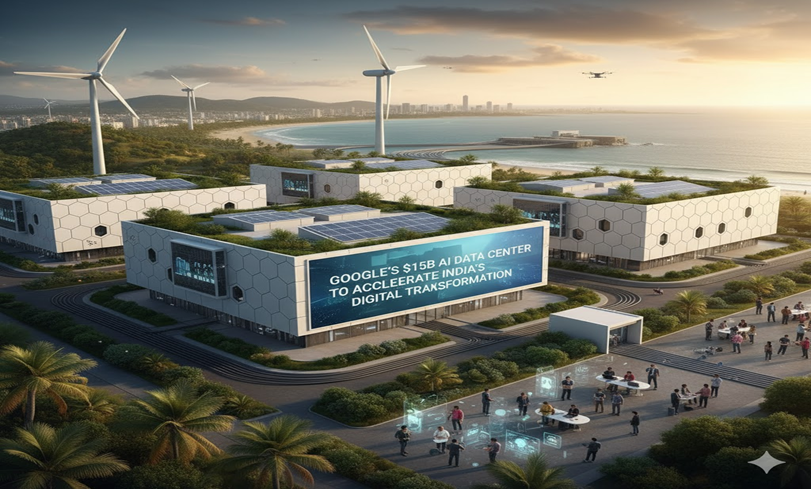

Google’s announcement to invest $15 billion in a massive AI data center and cloud infrastructure campus in Visakhapatnam signals a major leap in India’s digital development. Rather than being just another tech venture, this bold initiative aims to revolutionize the way India builds, trains, and deploys artificial intelligence at scale.
The Visakhapatnam campus will initially offer a 1-gigawatt capacity, transforming the city into a vital hub for advanced computing. Over time, this site will grow into a multi-gigawatt facility, equipped with top-tier infrastructure for AI model training, data processing, and cloud services. Significantly, it marks Google’s largest data center investment outside the United States, underlining India’s growing strategic importance.
This project’s ambition stretches well beyond powering global services like Search and YouTube. In fact, it is designed to empower Indian developers, startups, and businesses to build AI-powered solutions locally. This not only reduces latency but also ensures data remains governed under local laws, moving India toward digital sovereignty.
Additionally, Google’s plan includes deploying a new high-speed fiber network and establishing a subsea cable landing in Visakhapatnam. These efforts will greatly enhance India’s global internet connectivity, paving the way for more resilient and high-capacity digital infrastructure across various sectors.
To integrate this infrastructure seamlessly, Google is partnering with leading telecom and infrastructure companies. These collaborations are essential to aligning the project with national digital goals and regional development plans. Moreover, this move reflects Google’s confidence in India’s long-term potential to host large-scale, AI-driven digital ecosystems.
India’s rapid digital economy expansion further strengthens the timing of this initiative. The rise of technologies like cloud computing, IoT, analytics, and AI has sharply increased demand for local data centers and sovereign storage solutions. In response, Google’s investment directly addresses these needs and fills a critical infrastructure gap.
The state of Andhra Pradesh has emerged as a proactive partner in this journey. The state government is pursuing aggressive goals to attract several gigawatts of data center capacity. To support this, it is offering favorable policies, access to renewable energy, and robust industrial infrastructure. Clearly, the state sees this as a catalyst for economic growth, job creation, and technological prestige.
According to analysts, the project may add more than ₹10,000 crore to the state’s Gross State Domestic Product (GSDP) annually. It is also expected to generate around 190,000 direct and indirect jobs each year, spanning sectors such as construction, logistics, IT services, energy, and research and development. In short, this initiative is poised to spark a broader innovation economy in the region.
At its core, the campus is envisioned to become an “Emerging Technologies Cluster.” This cluster will anchor not only cloud and compute services but also enable progress in machine learning, generative AI, robotics, and edge computing. Over the long term, this ecosystem could serve as a global model for how developing nations fast-track AI adoption.
Nonetheless, the project is not without its challenges. Data centers consume large amounts of electricity and require highly efficient cooling systems. If powered by fossil fuels, such facilities risk elevating carbon emissions. However, Google has reaffirmed its commitment to integrating clean energy solutions. As renewable adoption continues to grow, the Visakhapatnam campus could become a regional benchmark for sustainable data center operations.
Another crucial factor is effective execution. Large-scale infrastructure projects demand coordinated efforts across central and state governments. Issues such as land availability, regulatory clearances, and power grid readiness must be addressed swiftly. If managed well, however, the long-term benefits will be substantial.
This ambitious investment may also trigger a competitive response from global tech giants. Amazon and Microsoft have already made considerable data center investments in India. Now, with Google entering the space at scale, the urgency to innovate locally, build faster, and reduce reliance on international compute resources is likely to intensify.
Indian developers, researchers, and startups stand to gain significantly from this. They will now have low-latency access to cutting-edge infrastructure, allowing them to train advanced AI models domestically. In turn, this will enable faster iteration and deployment in areas such as education, healthcare, agriculture, and climate tech.
Additionally, local data storage enhances compliance with national data protection laws and reinforces strategic digital autonomy. As AI becomes deeply integrated into public systems and critical infrastructure, these factors will only grow in importance.
In conclusion, Google’s $15 billion investment in Visakhapatnam is more than just a business move—it is a strategic commitment to shaping India’s AI-powered future. By aligning technology, policy, and infrastructure, this project has the potential to make Visakhapatnam a global tech hub and empower millions of Indians to harness the power of AI.