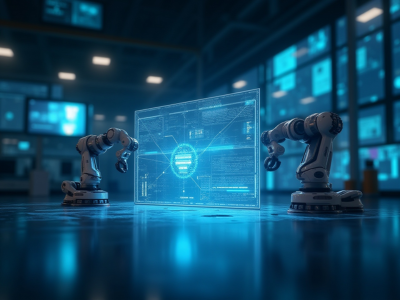

DataMesh has officially introduced DataMesh Robotics, a new embodied AI data product solution designed to transform industrial and facility operations. The launch marks a significant step in robotics training, as the company aims to provide robot manufacturers and application teams with a complete set of tools for building, simulating, and validating industrial tasks. The focus keyword DataMesh Robotics highlights the company’s ambition to reshape how embodied AI learns in dynamic environments.
Unlike traditional digital twin platforms that rely on static 3D models, DataMesh Robotics builds on the company’s FactVerse platform to create an “Executable Industrial Digital Twin.” This approach allows industrial environments to evolve in real time. Machines can move, processes can change, and events can be triggered, creating a simulation that mirrors real-world complexity. By doing so, DataMesh Robotics generates synthetic data that reflects actual industrial conditions, helping robots learn tasks more effectively.
The solution also addresses one of the toughest challenges in embodied AI: defining task objectives and reward signals. Industrial robots must complete multi-step workflows under strict safety rules, and DataMesh Robotics provides a low-code editor to configure these objectives. This makes training more accessible and reduces the need for deep technical coding knowledge. As a result, robotics teams can design reward strategies and constraints with greater clarity and efficiency.
DataMesh has already earned recognition from Gartner for its work in intelligent simulation and digital twin technologies. With this new launch, the company strengthens its position as a leader in industrial AI innovation. The platform supports integration with mainstream ecosystems such as NVIDIA Isaac Sim and Omniverse, ensuring compatibility with existing robotics R&D workflows. This flexibility allows enterprises to adopt the solution without disrupting their current systems.
Having completed prototype validation, the company now works with enterprise partners, including telecom operators and data labeling providers, on pilot projects. These collaborations aim to refine the solution and explore its potential in real-world industrial settings. With the digital twin market growing rapidly as industries increasingly rely on advanced simulation and automation, DataMesh plans to expand its asset library and task templates, making its platform even more versatile for diverse industrial applications.
CEO Jie Li emphasized the importance of dynamic environments in robotics training. He explained that robots must learn in worlds that change, just like real factories and warehouses. Static models are not enough to prepare robots for complex tasks. DataMesh Robotics provides evolving simulations, clear reward objectives, and end-to-end training loops, helping robotics teams deploy solutions faster and with greater safety.
The platform’s highlights include scalable synthetic data generation, automated ground-truth labeling, and multimodal outputs such as temperature and pressure variables. These features strengthen learning by exposing robots to conditions beyond visible data. Industrial teams can also simulate operations logic, such as starting or stopping production lines, switching process states, and handling exceptions. This creates a closed-loop training environment that mirrors actual industrial workflows.
DataMesh Robotics primarily serves robot manufacturers and robotics application teams. Typical use cases include assembly operations, warehouse navigation, facility inspections, and hazardous environment drills. The platform also supports multi-robot collaboration, enabling teams to model and evaluate complex tasks involving multiple agents.
The company is now inviting partners to join pilot collaborations and co-develop solutions. Interested organizations can contact DataMesh directly to explore opportunities. With this launch, DataMesh positions itself as a key player in industrial embodied AI, offering a solution that combines simulation, synthetic data, and reward configuration into one integrated system.
By focusing on dynamic business simulation, DataMesh Robotics sets itself apart from competitors. It delivers not only industrial-grade scenes but also environments that evolve with processes and events. This innovation could redefine how robots are trained, making them more capable of handling the unpredictable nature of industrial operations. As industries continue to adopt automation, DataMesh Robotics may become a vital engine for embodied AI training and deployment.