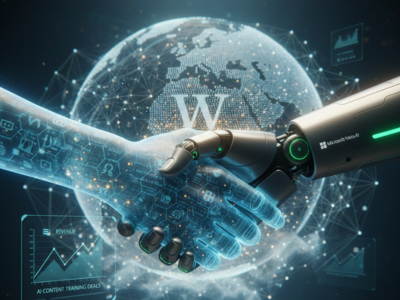

Wikipedia’s owner advanced a decisive plan to reshape how AI firms access its content. The Wikimedia Foundation announced paid partnerships with Microsoft, Meta, Amazon, Perplexity, and Mistral AI. Leading to the Microsoft Wikipedia AI agreement. The deals formalize large‑scale use and reduce reliance on uncontrolled scraping. Moreover, they extend a path first opened by Google’s 2022 arrangement. Consequently, the new model seeks sustainability for the nonprofit and predictability for enterprise users. Meanwhile, volunteers continue to power the encyclopedia’s living record of knowledge.
Wikipedia offers a scale that few repositories can match. It spans more than 65 million articles across hundreds of languages. Therefore, AI developers treat it as foundational training material. However, free scraping has strained servers and complicated traffic management. Furthermore, bot requests frequently arrive in bursts that disrupt caching and mirrors. Thus, paid access channels promise steadier performance and cleaner data delivery. In parallel, the Foundation aligns revenue with actual industrial usage patterns.
Lane Becker, who leads Wikimedia Enterprise, described the shift as pragmatic. He said enterprise buyers needed reliability, speed, and versioned updates. Additionally, he emphasized fair support for the infrastructure that underpins modern AI tools. Therefore, the commercial offering packages structured feeds and service guarantees. In turn, AI teams can schedule model refreshes with fewer surprises. Likewise, Wikimedia gains resources to expand moderation and engineering capacity.
Microsoft framed the collaboration around trustworthy information at scale. The company highlighted the need for curated, verifiable sources in model pipelines. Accordingly, the partnership enshrines predictable data access and responsible cost sharing. Moreover, it reduces redundant scraping that inflates network traffic and server load. Consequently, both sides benefit from clearer obligations and technical SLAs. Notably, the Microsoft Wikipedia AI agreement sets a template for future knowledge partnerships. It encourages balanced use while protecting community values.
Meta’s participation underscores the importance of multilingual coverage. Its models rely on diverse corpora and strong editorial standards. Therefore, volunteer‑edited pages provide grounded context and linked citations. Additionally, Perplexity and Mistral AI gain standardized snapshots suitable for benchmarking. Thus, teams can compare model iterations against consistent reference sets. Meanwhile, Amazon strengthens access for assistant features and retrieval systems. Altogether, the network signals industry consensus on ethically sourced training data.
Jimmy Wales welcomed AI training that respects community work. He affirmed that human curation improves model quality and behavior. However, he urged firms to share operational costs proportionally. Therefore, licensing ensures continued investments in servers, software, and safety. Moreover, formal channels discourage covert scraping and traffic obfuscation. In essence, the approach blends openness with sustainability. It keeps knowledge free for readers while asking the industry to contribute.
Traffic dynamics also accelerated this policy turn. Human pageviews softened as AI tools summarized answers upstream. Consequently, bot traffic surged, often obscuring identity and intent. Thus, enterprise agreements separate legitimate high‑volume access from opaque harvesting. Additionally, they deliver documentation and support for integration at scale. Therefore, customers can plan training runs without sudden throttles or inconsistencies. Meanwhile, communities receive steadier tools, faster rollbacks, and improved resilience.
Wikimedia also explores AI to assist editors, not replace them. Potential tools could flag broken links or outdated references. Furthermore, they might triage vandalism and suggest sources for verification. However, human editors would retain authority over final content. Consequently, standards like neutrality and verifiability remain intact. Likewise, transparent tooling and audit logs would guide deployment. Ultimately, technology would reduce drudgery while preserving editorial judgment.
Leadership changes accompany these developments. A new chief executive assumes responsibility for partner engagement and product evolution. Accordingly, the Foundation will refine pricing tiers and technical features. Moreover, it will expand communications around provenance and update cadence. Consequently, startups and incumbents can align pipelines with contractual certainty. In return, Wikimedia can budget for capacity upgrades and community programs. The cycle reinforces quality, stability, and shared accountability.
Critics will watch the details closely. They may question access equity, rate limits, or long‑term governance. Nevertheless, the underlying principle appears sound and timely. Heavy users should help maintain the infrastructure they depend on. Therefore, the Microsoft Wikipedia AI agreement illustrates a fair exchange of value. It turns a cost burden into a sustainable, mission‑aligned revenue stream. Furthermore, it encourages better technical hygiene and fewer scraping externalities. In the end, Wikipedia’s model adapts, yet its purpose endures.
The broader ecosystem benefits from this evolution. Developers gain dependable inputs for training and evaluation. Meanwhile, readers enjoy a more resilient public resource. Additionally, volunteers receive enhanced tools and less infrastructure volatility. Thus, cooperation supersedes contention in the data economy. The Microsoft Wikipedia AI agreement stands as a landmark in that shift. It validates that open knowledge and responsible monetization can coexist. Ultimately, the arrangement secures continuity for a vital civic utility. Consequently, it charts a path that other knowledge stewards can follow. Finally, it shows that ethical partnerships can scale with the industry.