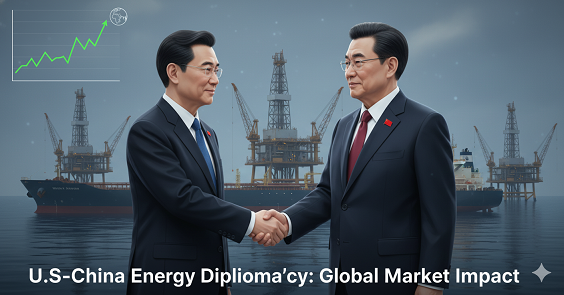

Global oil prices edged higher on Monday after the United States and China, the world’s two largest energy consumers, reached a preliminary agreement on a trade deal framework. The announcement eased market concerns over prolonged economic friction, boosting investor confidence in global demand prospects.
Brent crude climbed 46 cents, settling at $66.40 per barrel, while U.S. West Texas Intermediate (WTI) rose by the same margin to $61.96. The gains follow a strong rally last week, when Brent surged nearly 9% and WTI almost 8%. Analysts said fresh U.S. and EU sanctions on Russian oil companies reduced supply expectations, driving the previous price increase.
Investor sentiment has benefited from two primary developments. First, the preliminary U.S.-China trade agreement signaled a potential resolution to tensions that had threatened global growth. Second, sanctions on Russia have reinforced supply concerns, helping to counteract earlier oversupply fears that pressured markets earlier this month. According to Haitong Securities, these factors combined to create an environment of cautious optimism among traders.
On Sunday, U.S. Treasury Secretary Scott Bessent revealed that senior officials from both nations had agreed on a “very substantial framework” during negotiations in Kuala Lumpur. The framework prevents the U.S. from imposing full tariffs on Chinese goods and delays China’s rare-earth export restrictions. The agreement should lead to high-level talks between President Trump and President Xi Jinping later this week.
President Trump expressed optimism about the outcome, indicating plans to meet Chinese leaders in both the U.S. and China. “I think we’re going to have a deal with China,” he said, suggesting that the framework could evolve into a full agreement. Financial markets rose as investors expect easing trade tensions to boost global growth and increase energy demand.
Despite the optimistic tone, analysts cautioned that significant risks remain. Tony Sycamore, an IG strategist, said Russia might bypass sanctions with steep discounts or unregistered “shadow fleets” to maintain exports. Such actions could undermine the effectiveness of sanctions and destabilize markets.
Yang An, a Haitong Securities analyst, said failed Russian oil sanctions could revive oversupply concerns in the market. Last Thursday, Russian President Vladimir Putin downplayed sanctions on Rosneft and Lukoil, signaling Moscow’s intent to maintain energy exports. These developments have introduced a layer of uncertainty that could influence price movements in the weeks ahead.
Looking forward, investors will closely monitor additional progress in the U.S.-China trade negotiations and any strategic responses from Russia. Analysts noted that the combination of easing trade tensions and geopolitical developments in Russia will likely shape the trajectory of oil prices over the near term.
In the immediate term, markets have reacted favorably to the signs of collaboration between Washington and Beijing. The improved sentiment offers a measure of stability to the oil market, which has faced volatility due to concerns over supply, tariffs, and geopolitical risks. Traders are cautiously optimistic that ongoing discussions may strengthen global crude demand and sustain the recent price rally.
The U.S.-China trade framework represents a step toward easing uncertainty that has weighed heavily on commodity markets for months. By addressing potential tariffs and export restrictions, both nations are signaling their willingness to manage economic friction constructively. This development underscores the interplay between geopolitics and energy markets, illustrating how policy decisions can influence investor behavior and pricing trends.
Meanwhile, the sanctions imposed on Russia continue to create complex dynamics in global oil markets. While they restrict certain exports, Russia’s capacity to adjust logistics and pricing strategies introduces an element of unpredictability. Market participants are weighing these factors alongside trade optimism, resulting in cautious but positive trading patterns.
Overall, the combination of a U.S.-China trade framework and ongoing sanctions on Russia has contributed to a supportive environment for oil prices. While uncertainties remain, the market has found temporary relief as investors react to positive developments. The coming days will be critical in determining whether this momentum persists and whether broader geopolitical and economic factors continue to influence global crude oil prices.
Oil markets, therefore, remain sensitive to political and economic shifts. With the trade deal framework signaling reduced tensions and Russian sanctions introducing both constraints and uncertainties, investors are likely to remain attentive to policy developments. The outcome of these interactions will play a pivotal role in shaping oil prices and global energy market stability in the near term.