
Arteriovenous fistula (AVF) devices are becoming increasingly important in vascular access for patients who require long-term hemodialysis. As healthcare providers seek durable dialysis access, faster fistula creation, better maturation monitoring, and fewer complications, the market is shifting from conventional surgical tools to endovascular creation systems, monitoring technologies, maintenance devices, and data-driven surveillance.
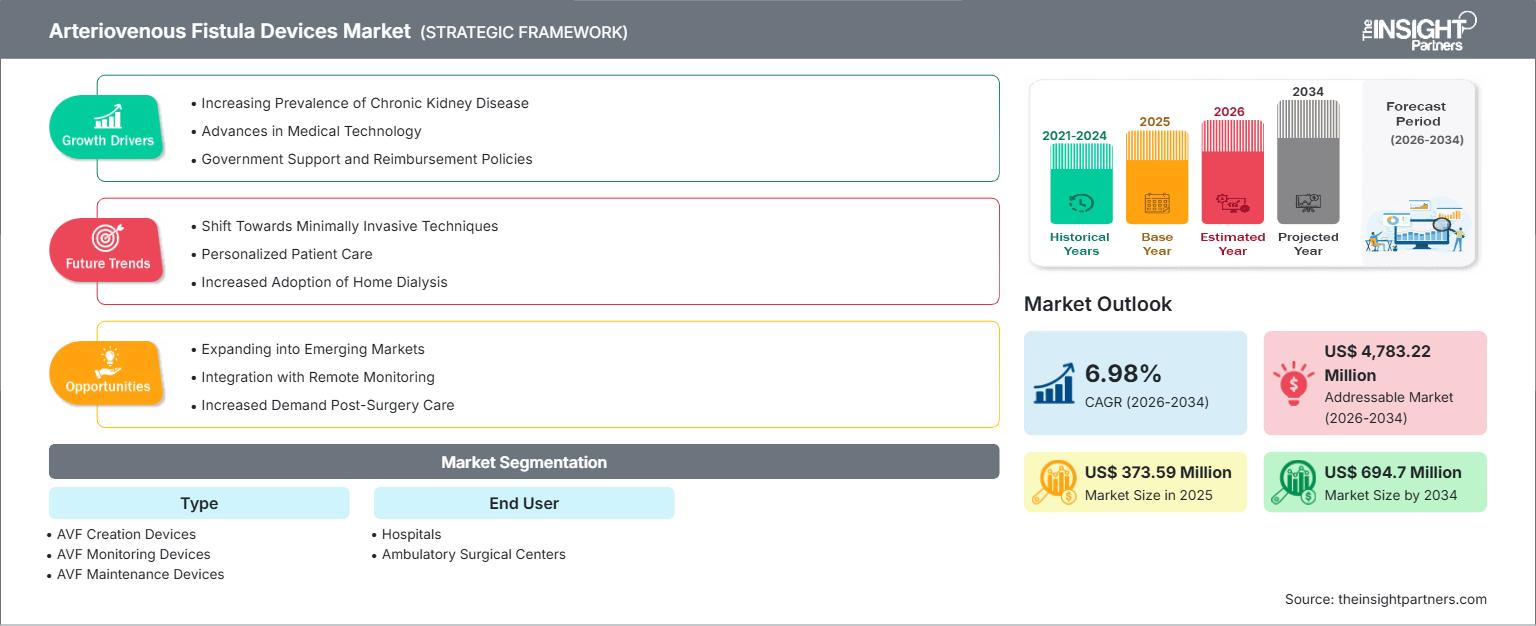
Quick answer: The global arteriovenous fistula devices market was valued at US$ 373.59 million in 2025 and is projected to reach US$ 694.7 million by 2034, registering a CAGR of 6.98% during 2026–2034. AVF creation devices represent the largest device category, while monitoring and lifecycle-management technologies are gaining importance.
1. What Are Arteriovenous Fistula Devices?
Arteriovenous fistula devices include products used to create, evaluate, monitor, and maintain an AV fistula—the connection between an artery and a vein used to provide vascular access for hemodialysis.
The market includes AVF creation devices, AVF monitoring devices, and AVF maintenance devices used across hospitals, ambulatory surgical centers, dialysis-related care settings, and vascular access programs.
For appropriate patients, AV fistulas are widely regarded as a preferred form of permanent hemodialysis access because of their durability and lower risk of infection compared with central venous catheters. However, fistulas can require time to mature, and some never become usable. This creates demand for technologies that improve patient selection, creation, maturation assessment, and long-term patency.
2. Why Is the Arteriovenous Fistula Devices Market Growing?
A major market driver is the continuing burden of chronic kidney disease (CKD). CDC data estimates that more than 1 in 7 US adults—around 35.5 million people—have CKD. As advanced kidney disease increases the need for renal replacement therapy, dialysis providers require reliable and durable vascular access solutions.
Another important driver is the shift toward minimally invasive AV fistula creation.
Endovascular AV fistula, or endoAVF, systems can create a fistula through catheter-based techniques instead of conventional open surgery in anatomically suitable patients.
BD's WavelinQ EndoAVF System uses two magnetic catheters and radiofrequency energy to create an AV fistula. Medtronic's Ellipsys Vascular Access System uses a single-catheter approach to create a proximal radial artery-to-perforating vein connection in eligible patients.
Competition is therefore shifting toward patient selection, technical success, maturation, time to cannulation, reintervention frequency, patency, workflow efficiency, and the total cost of vascular access.
3. Latest AV Fistula Technology Updates Shaping the Market
One of the most significant developments is the growing use of artificial intelligence and predictive analytics in vascular access management.
At its June 2025 Capital Markets Day, Fresenius Medical Care presented its Access360 approach, describing AI models across the AVF lifecycle—from pre-placement and maturation monitoring to long-term function and end-of-life assessment.
The approach illustrates how future vascular access management could combine electronic health records, dialysis-machine data, imaging, clinical measurements, photographs, acoustic signals, and predictive models to identify patients at higher risk of AV fistula failure.
4. New 2026 Evidence Adds to the EndoAVF Discussion
Clinical evidence surrounding endovascular AVF continues to evolve.
A study published in the January 2026 issue of Annals of Vascular Surgery followed 32 patients treated with the WavelinQ EndoAVF system. The study reported that 65.6% required an intervention before successful cannulation and found lower long-term primary patency compared with traditional surgical fistulas in this single-center cohort.
However, earlier multicenter real-world research involving 112 patients reported 97.3% technical success and strong two-year cumulative and functional patency among endoAVFs that matured.
These differing findings highlight an important market trend for 2026: adoption is likely to depend increasingly on comparative clinical evidence, appropriate patient selection, physician training, maturation protocols, reintervention requirements, and long-term outcomes, rather than technical success alone.
5. Which AV Fistula Device Segments Offer Strong Growth Opportunities?
AVF creation devices currently represent the largest portion of the market. The Insight Partners estimates that creation devices represented approximately 48–52% of the market in 2025.
However, AVF monitoring and maintenance could create attractive recurring opportunities because vascular access must be managed throughout its usable life.
Monitoring solutions can include ultrasound, blood-flow assessment, and emerging digital technologies designed to identify access dysfunction. Maintenance devices help clinicians address complications such as stenosis and thrombosis and preserve vascular access.
This is gradually creating an “AVF access lifecycle” market extending from vessel mapping and fistula creation through maturation, cannulation, surveillance, intervention, and eventual replacement.
6. Regional Outlook: Where Is Growth Likely to Be Strongest?
North America remains an important arteriovenous fistula devices market due to its established dialysis infrastructure, reimbursement pathways, procedural expertise, and adoption of endovascular vascular-access technologies. The region represented an estimated 34–38% market share in 2025.
Asia Pacific is expected to expand faster as dialysis capacity and renal-care infrastructure grow. China and India, in particular, could create opportunities for AVF creation, monitoring, and maintenance technologies.
In these emerging markets, commercial success is likely to depend not only on device performance but also on affordability, physician training, distribution networks, reimbursement, and local technical support.
7. What Will Define the AV Fistula Devices Market Through 2034?
Five developments are likely to shape the next phase of the market: wider adoption of minimally invasive AVF creation, predictive monitoring of fistula maturation and failure, increasing outpatient vascular-access procedures, stronger comparative clinical evidence, and integrated portfolios covering creation, monitoring, and maintenance.
The market is therefore evolving from individual devices into a more connected dialysis vascular-access ecosystem.
Companies that demonstrate measurable improvements in fistula maturation, patency, procedure efficiency, intervention requirements, patient outcomes, and total lifecycle cost may be better positioned to gain adoption.
Frequently Asked Questions
What is the size of the arteriovenous fistula devices market?
The global arteriovenous fistula devices market was valued at US$ 373.59 million in 2025 and is projected to reach US$ 694.7 million by 2034.
What is the expected CAGR of the AV fistula devices market?
The market is projected to grow at approximately 6.98% from 2026 to 2034.
What is an endovascular AV fistula?
An endovascular AV fistula is created using a catheter-based, minimally invasive technique rather than conventional open surgery. Patient anatomy and clinical suitability determine whether an endoAVF procedure is appropriate.
Which companies are active in the AV fistula devices market?
Companies analyzed in the market include BD, Medtronic, Abbott, Terumo Corporation, Fresenius Medical Care, B. Braun, Cook Medical, Teleflex, Vascular Pathways, and W. L. Gore & Associates.
Conclusion
Growth in the arteriovenous fistula devices market is being supported by demand for reliable hemodialysis access, minimally invasive AVF creation, better surveillance, and technologies designed to extend fistula usability.
The next phase of competition is likely to be shaped less by device novelty alone and more by evidence showing which technologies help clinicians create usable access sooner, identify problems earlier, improve long-term patency, and preserve vascular access over time.
For detailed market size forecasts, regional analysis, segmentation, competitive intelligence, and company profiles, explore the Arteriovenous Fistula Devices Market report by The Insight Partners.