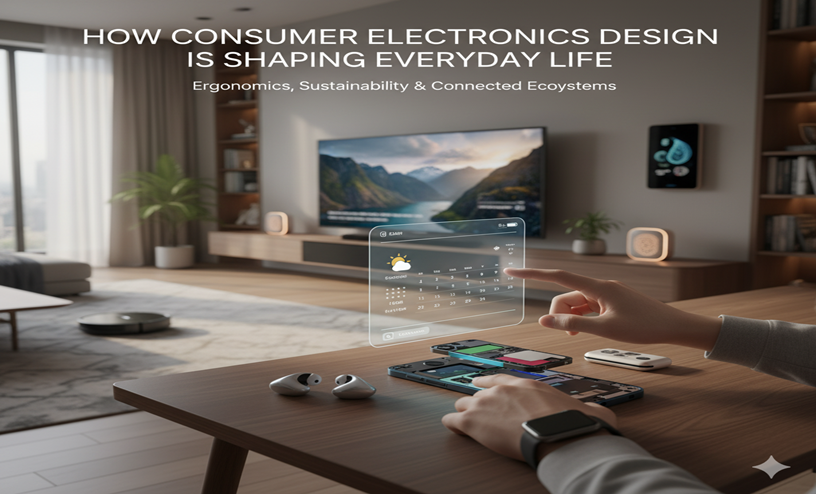

In today’s fast‑moving world, consumer electronics design plays an essential role in how we live, work, and interact. From the smartphone in your pocket to the smart thermostat on your wall, the innovations in design are constantly pushing boundaries. In this blog, I’ll explore several key trends and explain how they influence our daily routines.
1. Ergonomics Meets Intuition
Good design starts with how a device feels and responds. If a gadget is uncomfortable or unintuitive, people quickly abandon it. Designers increasingly focus on ergonomics so devices fit our bodies naturally. Moreover, they weave in intuitive controls so our learning curve is minimal.
For instance, touchscreens, voice commands, and haptic feedback have become staples. You don’t need a manual to swipe, pinch, or ask your assistant to set an alarm. Because of this, everyday interactions become smoother and more natural.
2. Smaller, Yet More Powerful
We expect more features in slimmer forms. Thanks to breakthroughs in microchips, display technology, and battery efficiency, devices no longer need to be bulky. Foldable screens and rollable displays now offer large viewing areas without taking up pocket space.
Wireless earbuds are another great example. They pack audio chips, battery, Bluetooth radios, and sensors, all in a compact shell. As a result, portability doesn’t require sacrificing performance.
3. Sustainability at the Core
Consumers increasingly demand that devices respect the planet. In response, engineers and designers are adopting eco‑friendly materials, modular architectures, and energy‑efficient components.
Brands like Fairphone promote repairability and modular swaps so users can upgrade or replace parts instead of discarding a whole device. Meanwhile, companies use recycled plastics and design programs to recover and reuse parts from old devices. By doing so, they reduce e‑waste and carbon emissions.
4. Connected Ecosystems and IoT
In the past, gadgets tended to operate in isolation. Today, they’re part of a larger ecosystem. The Internet of Things (IoT) connects appliances, wearables, speakers, and even your home security system.
Thus, your smartwatch might alert you when the fridge door is open or tell your speaker to dim lights when it senses you're relaxing. Because devices talk to each other, daily tasks become more seamless.
5. Personalization Through Artificial Intelligence
Generic always gives way to customized. AI helps make devices smarter by learning from your habits, preferences, and routines. As a result, the experience becomes uniquely yours.
Smart assistants like Siri, Alexa, or Google Assistant adjust recommendations, schedule reminders, or control your home based on your behaviors. Meanwhile, camera software uses AI to optimize light, reduce noise, or choose the best focus automatically—so your photos look better without manual tweaking.
6. Immersion with AR and VR
Augmented Reality (AR) and Virtual Reality (VR) move us beyond conventional screens. They immerse us in experiences—whether for gaming, remote work, education, or even navigation.
Developers leverage frameworks like ARKit and ARCore to overlay digital content on real environments. Similarly, devices like the HoloLens and Oculus Quest let users inhabit fully virtual worlds. With these tools, interaction becomes more natural and spatial, reshaping how we consume content.
7. Smarter Power Systems
Battery life has long challenged designers. Today, innovations in solid‑state batteries, fast charging, and wireless power are changing the game.
Solid‑state batteries promise higher energy density and safety. At the same time, Qi wireless charging and magnetic docks remove cables from daily use. Because of these advances, devices last longer, charge faster, and free us from cords.
8. Security by Design
Privacy and security are no longer afterthoughts. Modern electronics integrate biometric measures—such as fingerprint sensors, facial recognition, or voice authentication—to protect access. Devices also rely on secure enclaves and end‑to‑end encryption to guard against data breaches.
When design is built in safety from the ground up, users gain peace of mind without choosing convenience over protection.
9. Modular and Adaptive Systems
Rigid, closed designs are giving way to modular architectures. Users can swap components—like upgrading memory, sensors, or cameras—without replacing the whole device.
In the same way, laptops with modular internals let users replace battery packs, SSDs, and GPUs. By allowing flexibility, devices become more sustainable, longer lasting, and better suited to evolving needs.
10. What’s Next: The Future Beckons
The next chapter in consumer electronics design will probably blur the lines between human and machine. Emerging trends such as brain–computer interfaces, self‑healing materials, flexible e‑paper displays, and empathetic AI promise even more intimate and intelligent experiences.
In the years ahead, we may control devices with thought, wear electronics as skin, or have machines that adapt on their own. If so, the design priorities will shift even more toward ethics, user well‑being, and environmental balance.
Conclusion
Consumer electronics design isn’t just about how things look; it’s about how they feel, how they connect, and how they evolve. From ergonomic interfaces and AI personalization to sustainable materials and modular systems, every innovation shapes our daily lives.
As designers push forward, our expectation will be: smarter, kinder, more intuitive devices that support us without friction. In the end, the best technology is invisible; it just works.