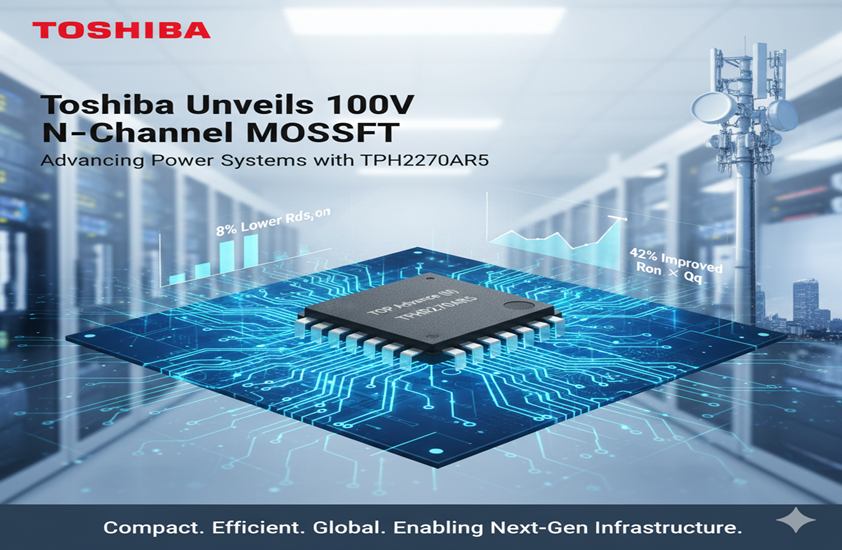

Toshiba Electronic Devices & Storage Corporation has introduced a high-efficiency 100V N-channel power MOSFET, designated the TPH2R70AR5. This device utilizes the company's newest U-MOS11-H process technology. Consequently, the product aims to significantly improve performance in switched-mode power supplies (SMPS) commonly found in data centers, communications infrastructure, and various industrial applications. Already, worldwide shipments of this innovative new MOSFET have begun.
Engineers designed the TPH2R70AR5 to provide much better power conversion efficiency than predecessor models. Indeed, this new device offers remarkable performance upgrades over previous-generation devices. Specifically, it achieves approximately 8% lower drain-source on-resistance (R on) when compared to Toshiba’s older U-MOSX-H process products.
Furthermore, the device demonstrates a substantial 37% lower total gate charge (Q g) than those same products. Therefore, the combination of these two factors reduces the R on ×Qg figure of merit by 42%, which effectively minimizes both conduction and switching losses. Ultimately, these dramatic improvements directly translate into better energy efficiency for demanding power systems.
Moreover, the TPH2R70AR5 incorporates Toshiba’s proprietary lifetime control technology for even greater performance. This critical advancement reduces the body diode’s reverse recovery charge (Q rr) by 38%. Additionally, it improves the R on ×Q rr performance by an impressive 43%. These figures hold crucial importance in high-speed switching applications because diode recovery characteristics directly impact the overall circuit performance and thermal behavior.
Importantly, the TPH2R70AR5 comes packaged in the compact and thermally efficient SOP Advance (N) form factor. This specific package offers outstanding heat dissipation while remaining compatible with standard mounting footprints. Consequently, designers can integrate the device into their existing board layouts easily, avoiding the need for major redesign efforts.
To support a seamless adoption process, Toshiba also provides comprehensive simulation models for this new MOSFET. These models include a G0 SPICE model, which allows for rapid circuit prototyping. It also includes a G2 SPICE model that enables high-accuracy simulations, which proves especially helpful when evaluating switching behavior under different load conditions. This robust support aims to accelerate development time and ensure high design reliability for customers.
Toshiba emphasizes that the TPH2R70AR5 delivers “industry-leading trade-off characteristics,” making it an ideal component for power conversion systems that demand high efficiency and minimal power loss. In applications like data centers and 5G base stations, where energy consumption represents a major operational cost, such highly efficient devices can play a vital role in reducing total power usage and the overall thermal load.
Furthermore, as various industries shift toward more sustainable energy practices, the market demand for low-loss power semiconductors continues to grow. With this important trend in mind, Toshiba’s U-MOS11-H platform represents a key strategic move to address both demanding technical performance needs and evolving environmental goals.
Moving forward, Toshiba plans to expand its low-loss MOSFET lineup by building upon the U-MOS11-H platform to introduce devices in other voltage classes. Simultaneously, the company remains committed to offering comprehensive design support tools to assist developers in optimizing power solutions with minimal delay.
In essence, Toshiba’s TPH2R70AR5 introduces significant performance improvements in terms of on-resistance, gate charge, and diode recovery, all within a compact and flexible package. It clearly reflects the company's ongoing commitment to innovation in power device technology, aiming to deliver higher efficiency, better thermal performance, and simplified system design for industrial and infrastructure markets.
By launching this next-generation power MOSFET, Toshiba strengthens its position in the competitive semiconductor market and supports global efforts to improve energy efficiency in mission-critical electronics systems.