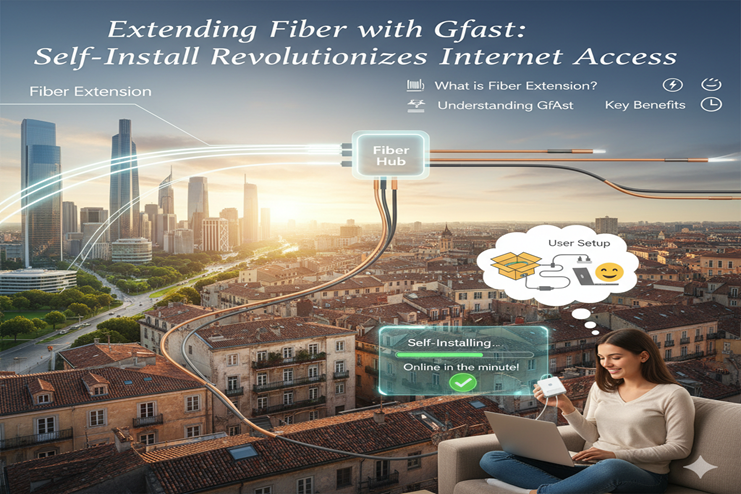

In today’s connected world, high‑speed internet is no longer optional; it’s essential. Whether people stream video, work remotely, or run cloud‑based applications, they expect broad bandwidth, minimal latency, and reliable service. However, delivering fiber optic connectivity to every home and business remains a challenge, especially in dense urban settings or older buildings. Fortunately, a clever hybrid approach is transforming the equation: Fiber Extension using Gfast technology, paired with self‑installation.
Below, I explore how this solution works, why it matters, and when it makes sense, all while keeping explanations clear and engaging.
What is Fiber Extension, and Why Do We Need It
Traditional fiber-to-the-home (FTTH) provides a direct fiber link from the network to the end user. While it offers excellent performance, it can be costly or impractical in some cases. For example, older or historic buildings may restrict new fiber runs, and permitting or trenching can delay deployment.
That’s where Fiber Extension comes in. It leverages existing copper or coaxial wiring to “bridge the final gap” between the fiber network and the user’s premises. In effect, you carry the signal over fiber as far as feasible, then switch over to copper/ coax using Gfast in the last leg. Thus, you preserve most of the fiber’s advantages while minimizing disruption and cost.
In other words, it’s a smart hybrid: fiber for the heavy lifting, and copper/ coax for the last stretch.
Understanding Gfast: High Speed Over Existing Lines
So, what exactly is Gfast? Pronounced “jee-fast,” it’s a broadband access technology that transmits very high speeds, often up to gigabit levels, over short lengths of copper or coaxial wire. Because it leverages existing wiring within a building or property, Gfast is ideal for dense, constrained environments.
Critically, Gfast is well-suited for self-installation. With a Gfast-compatible modem or customer-premises equipment (CPE), the user can connect to the existing line and power the unit without needing a technician’s visit. In many cases, users can be online within an hour by following simple plug-and-play instructions.
Because deployment doesn’t require re‑wiring, waiting for construction crews, or negotiating access, Gfast drastically accelerates time-to-service, a key differentiator in competitive broadband markets.
The Traditional Installation Model: Pain Points
Before Gfast self-installation, deploying high-speed internet generally followed a rigid workflow:
- The operator schedules a technician visit.
- The technician enters the property, installs fiber drops, or terminates wires.
- The user must be home during that window.
- If the technician can’t complete the job (access issues, wiring problems, etc.), multiple visits may be necessary.
This approach introduces delays, increases costs, and frustrates users who may need to take time off or deal with repeated scheduling. From the provider’s perspective, no-shows, multiple visits, and labor costs all erode margins.
In contrast, self-installation flips that model: you don’t depend on availability, in‑house access, or complex logistics.
How Gfast Self-Installation Works
When combining Fiber Extension with Gfast self-installation, the setup becomes remarkably simple for the user. Here’s the typical flow:
- Delivery of Device: The provider ships a Gfast-enabled modem or CPE to the subscriber.
- User Setup: The user plugs the CPE into an existing telephone or coax socket and connects power.
- Configuration: The device auto-provisions itself via remote management over the fiber network.
- Online: Within minutes, the connection becomes active, often without any user intervention beyond powering on.
Because no special wiring or technician access is necessary, the process becomes plug-and-play. Users gain control over when and how they activate service, whether late nights, weekends, or whenever convenient.
Key Benefits of Gfast Self-Installation
This hybrid approach provides multiple advantages across stakeholders:
- Faster deployment: Without needing technician visits, providers can scale rollouts quickly and reach many more users in less time.
- Reduced costs: Eliminating in-home service calls cuts labor, vehicle, and scheduling expenses.
- Convenience for users: Subscribers don’t need to wait at home; they activate service on their own schedule.
- Scalability: Providers can reach neighborhoods or multi-dwelling units (MDUs) that were previously cost-prohibitive.
- Sustainability: Fewer technician trips mean fewer emissions and a smaller environmental footprint.
- Improved accessibility: More homes, especially those in underserved zones or historic buildings, become serviceable without major construction.
In short, Gfast self-installation empowers users while streamlining operations.
When is This Approach Ideal?
Fiber Extension using Gfast self-installation suits several scenarios:
- Dense urban or MDU environments, where running fiber into every unit is expensive or structurally constrained.
- Legacy buildings or heritage properties, where new fiber cabling would violate preservation rules.
- Locations with existing copper or coax plant, which can be repurposed to reach end users.
- Competitive markets, where fast activation and low cost of entry could become differentiators.
- Broadband adoption goals, especially in areas underserved by pure fiber rollout.
However, it is not a universal solution. In areas with long copper runs or heavily degraded lines, performance might not match pure fiber. Thus, operators must assess line conditions and distance before deploying.
Challenges and Considerations
While promising, this model presents some challenges:
- Line quality and distance: Copper degradation or longer runs may limit achievable bandwidth.
- Interference and crosstalk: In dense wiring environments, signals may degrade without proper mitigation.
- Customer support: While self-installation is simple, some users may still require remote or phone support.
- Fallback paths: Providers must plan for cases where self-install fails — perhaps scheduling technician intervention as backup.
- Interoperability and standards: Ensuring devices and systems conform to current Gfast and broadband protocols is essential.
These challenges aren’t insurmountable, but they require planning, engineering diligence, and operational readiness.
Realizing the Potential: Strategic Impact
By adopting Fiber Extension with Gfast and self-installation, service providers gain agility in network growth and competitive leverage. They can:
- Accelerate subscriber acquisition, especially in underserved areas.
- Optimize operational efficiency, deploying more with fewer resources.
- Lower customer acquisition costs, as faster activation reduces churn.
- Compete on speed and convenience, not just price.
Meanwhile, end users benefit from high speeds, lower installation hassle, and faster time-to-online.
In effect, this model unlocks fiber-like connectivity for places that fiber alone cannot reach (or cannot reach cost-effectively). It transforms the last mile from a barrier into an opportunity.
Conclusion
As demand for ultra-fast connectivity surges, fiber alone cannot always be the sole answer. Fiber Extension using Gfast self-installation offers a powerful complementary tool. By leveraging existing copper or coax wiring and placing installation control in the hands of the user, it radically simplifies deployment, cuts costs, and accelerates access.
In a digital age where convenience and speed matter most, this hybrid approach bridges the last mile smoothly. Service providers must embrace this strategy to stay agile, and users will enjoy the benefits of high-speed connectivity without the headaches.
Indeed, the future of high-speed internet is not just about fiber everywhere; it’s about deploying the right technology smartly. With Gfast self-installation, that future arrives faster.