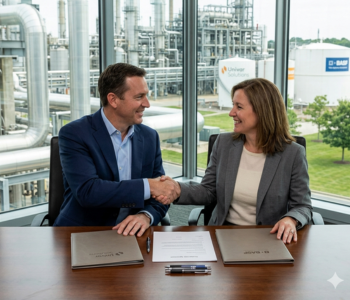

Loop Chemicals announced the licensing of a thermochemical looping ammonia technology from Sandia National Laboratories. After obtaining a license for ammonia technology from Sandia National Laboratories, US-based Loop Chemicals is making a major move toward transforming ammonia production. To promote decentralized manufacturing and strengthen supply chain resilience, the agreement represents a significant turning point in the development and commercial application of advanced ammonia technology.
The thermochemical looping technology developed at Sandia in association with Arizona State University is the foundation of the recently licensed ammonia technology. This approach introduces a unique method of ammonia synthesis that differs from traditional large-scale production systems. Loop Chemicals aims to lower capital intensity and provide a more adaptable, scalable manufacturing plan by using this innovative approach.
The company's initial focus will be on distributed ammonia production for fertilizer markets. Bringing ammonia manufacturing closer to agricultural regions, the application should reduce the requirement for transportation and reduce supply chain disruptions. In the future, Loop Chemicals plans to explore ammonia as a hydrogen carrier and alternative fuel. This fits with industry trends that see ammonia as a way to support cleaner energy systems. However, maintaining long-term cost competitiveness and ongoing technology validation will be necessary for commercial success.
Loop Chemicals started at the Massachusetts Climatetech Studio, a program designed to bring early-stage technologies from research institutions to market. At the end of the program, the company received a competitive grant that is now funding the development of a prototype reactor. Ongoing collaboration between Loop Chemicals, Sandia, and Arizona State University has helped ammonia technology evolve from research to practical use.
The company's leadership has highlighted the broader strategic and economic advantages of ammonia technology. Dan Doble, CEO of Loop Chemicals, states that the project's objectives are to boost farmers' economic outcomes, strengthen domestic fertilizer supply chains, and reduce dependence on imports. Furthermore, the corporation believes that localized ammonia manufacturing might improve supply reliability and create employment opportunities in rural areas.
From a research standpoint, Sandia National Laboratories has emphasized how this technology may affect domestic production capacity and energy security. This licensing agreement is a reflection of the growing significance of transferring lab-scale ideas into commercially viable solutions. Stakeholders in the Climatetech Studio program have also cited this development as a perfect example of how collaborations between companies and academic institutions can accelerate commercialization.
This partnership represents a wider trend of shifting towards decentralized, more sustainable methods of producing chemicals and energy. However, to succeed at a large scale, ongoing cooperation, funding, and regulatory backing will be necessary. As Loop Chemicals advances with prototype development and commercialization, industry experts will be looking closely at the progress of the company to see if this technology can help to create the framework for future innovations.
Overall, Loop Chemicals' licensing of Sandia's ammonia technology is a calculated move toward repositioning ammonia production to meet modern market demands. Furthermore, this partnership demonstrates the increasing need to employ modern technology solutions to solve issues of long-term sustainable practices and increased industrial efficiency.