
When working in composites or coatings, understanding the difference between saturated polyester resin (SPR) and unsaturated polyester resin (UPR) can dramatically affect your project’s performance. Both are polyester resins, yet they vary significantly in structure, curing process, and industrial use. Knowing these differences helps you make smarter material choices.
Chemical Structure and Reactivity
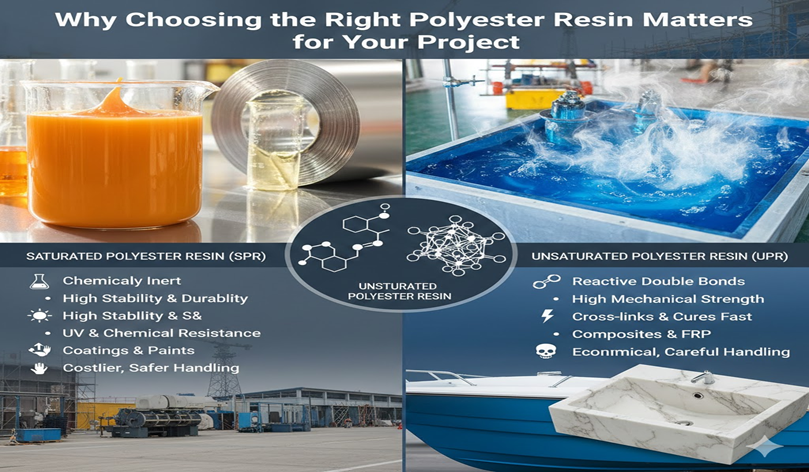
At the heart of the distinction lies the molecular backbone. Saturated polyester resin features fully saturated carbon chains with no double bonds in its main chain. This stable structure makes it chemically inert and resistant to many environmental changes. On the other hand, unsaturated polyester resin contains double bonds in its backbone. These unsaturated sites serve as reactive points, enabling cross-linking when a reactive monomer (like styrene) is added and a catalyst is introduced. Because of this, UPR undergoes free-radical polymerization and cures into a rigid, three-dimensional network. In contrast, SPR does not cross-link in the same way; its curing typically involves slower processes or external hardeners.
Production & Processing Differences
Producing saturated polyester resin is relatively straightforward. Manufacturers react polybasic acids with polyols under controlled conditions, yielding a polymer that can be cured at room temperature. Its processability and stability make it popular for coatings and industrial paints.
Conversely, unsaturated polyester resin production is more involved. The resin is synthesized by reacting unsaturated dicarboxylic acids (like maleic anhydride) with polyols, then blending the prepolymer with a vinyl monomer, usually styrene, to make it curable. After this step, a peroxide or other catalyst triggers cross-linking, converting the resin into a thermoset.
Mechanical and Chemical Properties
Because of its non-reactive backbone, saturated polyester resin offers excellent stability and resists chemical attack, UV degradation, and weathering. Its strength is consistent, and it retains its shape well over time.
On the flip side, UPR’s cross-linked structure provides high mechanical strength, especially when reinforced with fibers like glass. This makes UPR ideal for structural applications. Still, some unsaturated resins can be more brittle, though engineered formulations can adjust their flexibility.
When it comes to chemical resistance, SPR tends to outperform UPR. Saturated resins resist aggressive solvents, acids, and prolonged UV exposure better than many unsaturated variants. But once UPR has cured fully, its cross-linked structure also provides good resistance, especially to water and corrosion when reinforced well.
Thermal Behavior & Curing
Unsaturated polyester resins are thermosetting. They cure irreversibly via cross-linking, forming durable, heat-stable networks. This makes UPR suitable for high-stress or long-term structural uses. In contrast, saturated polyester resins can behave like thermoplastics (or can be set using heat or other curing agents), depending on how they are formulated.
The curing of UPR is often faster, especially when using initiators like methyl ethyl ketone peroxide (MEKP). SPR, with its lack of reactive double bonds, cures more slowly and may demand higher temperatures or specific hardeners.
Applications & Use Cases
Because of its durability and chemical resistance, saturated polyester resin is widely used in coatings, especially coil coatings, paints, adhesives, and films. It is a go-to resin for protective finishes in demanding environments such as automotive metal paints and industrial coatings.
In contrast, unsaturated polyester resin excels in composite manufacturing. When reinforced with glass fiber, UPR forms fiber-reinforced plastics (FRP), which are lightweight yet strong. You’ll often find UPR in boat hulls, construction panels, artificial marble, and bathroom fixtures. It is also used in high-tech fields like aerospace, where UPR’s cross-linked networks offer structural stability.
Cost & Practical Considerations
From a cost perspective, unsaturated polyester resin is generally more economical than saturated polyester resin. Its rapid curing and compatibility with common monomers like styrene further boost its appeal for large-volume composite production.
On the other hand, SPR tends to be costlier. But the higher price often pays off in long-term durability, chemical resistance, and less maintenance, especially for coating applications.
However, you should also factor in safety and handling. UPR typically requires careful handling: its reactive monomers (e.g., styrene) and peroxide catalysts can be hazardous. On the contrary, SPR is more chemically inert and poses fewer risks in handling, though any resin work should still follow safety protocols.
Choosing the Right Resin for Your Needs
To pick the right resin, start by defining your project requirements clearly. Do you need high strength? Go for UPR, especially if you plan to reinforce it with fibers. Do you want superior weather resistance and long-term stability? SPR may be more suitable.
Also, consider your curing constraints. If you need rapid, room-temperature curing, unsaturated polyester resin with a catalyst is ideal. But if your manufacturing setup allows for longer cure cycles or controlled heat, saturated resins may work better.
Finally, factor in cost and safety. Balance upfront resin costs against lifetime performance, and always follow recommended handling guidelines, particularly for UPR systems involving reactive monomers and initiators.
Conclusion
Both saturated and unsaturated polyester resins bring unique advantages to different industrial scenarios. Saturated polyester resin offers excellent chemical resistance, stability, and durability, while unsaturated polyester resin shines in structural strength, cross-linking capability, and cost-efficiency. By understanding their fundamental differences from molecular structure to curing behavior, you can make an informed choice that aligns with your application’s goals. Whether you’re building composites, protective coatings, or fiberglass products, selecting the right polyester resin can elevate your performance and longevity.