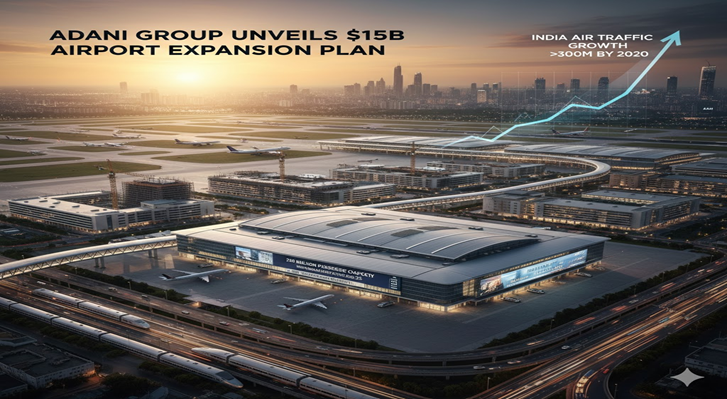

The Adani Group has announced a $15 billion initiative to expand its airport network across India over the next five years. Consequently, the expansion aims to raise the company’s annual passenger handling capacity to 200 million, reinforcing its role as a leader in India’s growing aviation industry.
The plan includes building new terminals, extending taxiways, and constructing a runway at the upcoming airport near Mumbai. That is expected to start operations on December 25. At the same time, the group will modernize airports in Ahmedabad, Jaipur, Thiruvananthapuram, Lucknow, and Guwahati, significantly strengthening the nation’s aviation infrastructure.
To fund this expansion, the company will use debt for roughly 70% of the cost over five years, while equity will cover the remaining portion. These upgrades will boost overall airport capacity by more than 60%, excluding additional contributions from the new Mumbai-adjacent and Guwahati facilities opening this month.
Moreover, the expansion aligns closely with projected air traffic growth. Analysts predict that domestic and international passenger numbers in India will exceed 300 million annually by 2030. Therefore, the increased capacity will enable Adani to handle nearly two-thirds of the anticipated traffic, solidifying its leadership in the aviation sector.
This initiative also builds on the airports’ earlier privatization. Six of the upgraded airports previously operated under state management before transitioning to private ownership in 2020. The broader privatization plan continues, suggesting additional airports may be leased or sold in the near future.
Proponents believe the project could transform India’s aviation infrastructure. New terminals and runways are expected to relieve congestion, minimize flight delays, and provide passengers with improved amenities. Furthermore, better airport connectivity is likely to stimulate regional economic growth and expand tourism opportunities nationwide.
Nevertheless, the project faces considerable challenges. Heavy reliance on debt poses financial risks if passenger growth does not reach anticipated levels. Additionally, coordinating airport upgrades across multiple cities requires careful planning of roads, utilities, and local transportation infrastructure.
Despite these challenges, success could reshape the country’s airport landscape. Modernized facilities and reduced congestion will benefit both travelers and airlines, while positioning India competitively in the global aviation market. The investment could also set new operational and service standards.
Effectively, the Adani Group is investing in infrastructure while betting on India’s growing air travel demand. By scaling up capacity, the company aims to improve connectivity and enhance convenience, efficiency, and passenger experience by 2030.
The plan adopts a phased approach, timing construction and upgrades to match projected growth. This method ensures smooth operations and maximizes the benefits of increased airport capacity. Combining new facilities with existing upgrades provides an integrated solution to India’s aviation challenges.
Additionally, the project may attract further private investment into India’s airport sector. By demonstrating successful large-scale modernization, Adani could encourage other companies to participate, boosting competition and overall service quality. Consequently, passengers may benefit from higher efficiency and improved airport experiences.
Upgraded airports are also expected to enhance operational safety and incorporate advanced technology. Automated check-ins, modern baggage handling, and real-time monitoring systems will improve reliability, streamline processes, and reduce delays for travelers.
Regional economies stand to gain from these developments as well. Enhanced connectivity encourages business travel, tourism, and investment in emerging markets. As a result, the airport upgrades could support broader national development goals beyond aviation.
In conclusion, the Adani Group’s $15 billion expansion represents a transformative step in India’s aviation industry. Through the construction of new airports and the modernization of existing ones, the company is preparing for growing passenger demand. These initiatives combine advanced infrastructure, operational efficiency, and superior passenger experience to strengthen India’s position in global aviation by 2030.