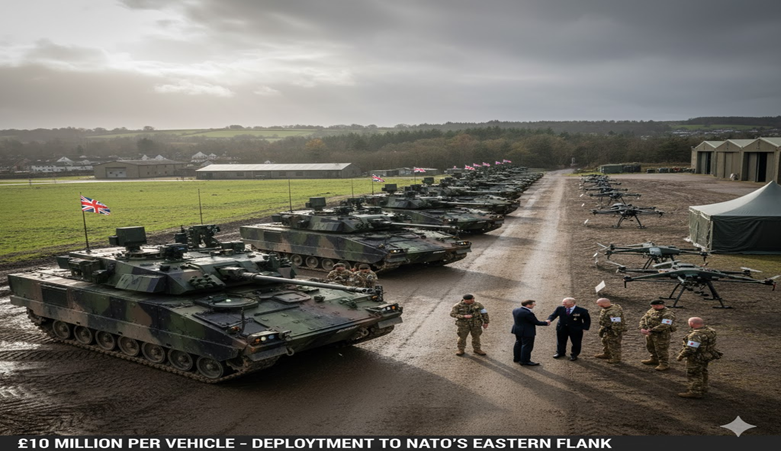

After an eight-year delay, the United Kingdom’s Ministry of Defence has officially received its first fifty Ajax armoured reconnaissance vehicles. Each vehicle costs approximately £10 million. Moreover, the army will deploy them to NATO’s eastern flank to strengthen Britain’s defensive presence. This announcement marks the long-awaited completion of a programme that faced repeated postponements and major technical setbacks.
Junior Defence Minister Luke Pollard confirmed that the vehicles are ready for service. At the same time, he openly acknowledged the missed deadlines in 2017, 2020, and 2021. He stated that the ministry has learned significant lessons from those failures. Consequently, future procurement will follow shorter, more efficient timelines. Although the Ajax project began in 2010, officials only approved the final contract years later, reflecting deep administrative delays within the defence acquisition system.
Ajax is designed for advanced reconnaissance missions. Its three-person crew operates safely inside the armoured vehicle. The system features a network of sensors and cameras that collect battlefield intelligence across complex environments. Despite scepticism from some experts, the British military continues to regard Ajax as essential. However, critics question its relevance amid the growing influence of inexpensive drones dominating modern warfare.
Recent conflicts, particularly in Ukraine, demonstrate how drones destroy costly armoured platforms with minimal investment. Therefore, analysts worry that Ajax’s late arrival limits its strategic value in a rapidly changing military landscape. Nevertheless, defence officials insist that Britain does not intend to fight like Ukraine’s forces. Instead, they plan to use Ajax for reconnaissance roles where drones might falter due to endurance or weather limitations.
A vehicle commander explained that drones struggle in windy conditions and cannot maintain long-duration missions due to battery constraints. Ajax, by contrast, can operate continuously for up to a week without requiring the crew to exit. Thus, it provides sustained surveillance capabilities. Consequently, Ajax complements drone assets rather than competes with them.
The UK has ordered 589 Ajax units and related variants, with full delivery expected by the end of the decade. The prolonged delay has damaged the programme’s reputation. As a result, observers question its cost-effectiveness and the reliability of the procurement system. Modern conflicts increasingly demand agility and technological adaptation. Unlike previous tank-focused programmes, Ajax represents a shift toward agile reconnaissance and intelligence collection for hybrid warfare.
During a visit to the Merthyr Tydfil manufacturing site in South Wales, Pollard admitted that setting up the contract took far too long. He pledged to reduce future defence contracting time from “many, many years” to “only a few months.” He also highlighted that these deliveries demonstrate Britain’s dedication to NATO defence and the strategic importance of protecting Europe’s eastern front. Additionally, producing Ajax supports over 4,100 British jobs, linking defence innovation to domestic employment.
Still, military observers remain cautious due to Ajax’s troubled testing history. Trials in 2020 and 2021 revealed excessive vibration and cabin noise. These defects caused hearing issues for some soldiers, requiring extended medical assessments. Defence officials later confirmed that engineers had resolved the problems. Nevertheless, some critics call for further testing to ensure safety and efficiency. If issues persist, the vehicles may fail to meet operational expectations in today’s fast-evolving combat environment.
Despite these concerns, British commanders express confidence in Ajax’s operational potential within combined-force missions. They emphasize that the system’s primary purpose is reconnaissance and intelligence gathering rather than mass tank warfare. Ajax can probe enemy positions, guide infantry, and operate where drones cannot provide lasting support. While drones remain cost-effective, they cannot match Ajax’s endurance, payload capacity, or protection against jamming and harsh weather.
As a result, Ajax plays a vital complementary role in Britain’s tactical strategy. It enhances coordination between armoured units, air assets, and ground troops. Moreover, it enables sustained surveillance in remote locations, improving situational awareness for commanders.
In conclusion, the arrival of Ajax vehicles signals both achievement and reflection. It celebrates progress after prolonged delays while encouraging scrutiny of traditional vehicles in a drone-centric battlefield. Consequently, the vehicle’s ultimate value depends on its integration within modern warfare doctrines and the army’s ability to evolve alongside emerging threats. Ajax’s success will rely not only on technical capability but also on strategic foresight in deploying it during complex, ever-changing conflicts.