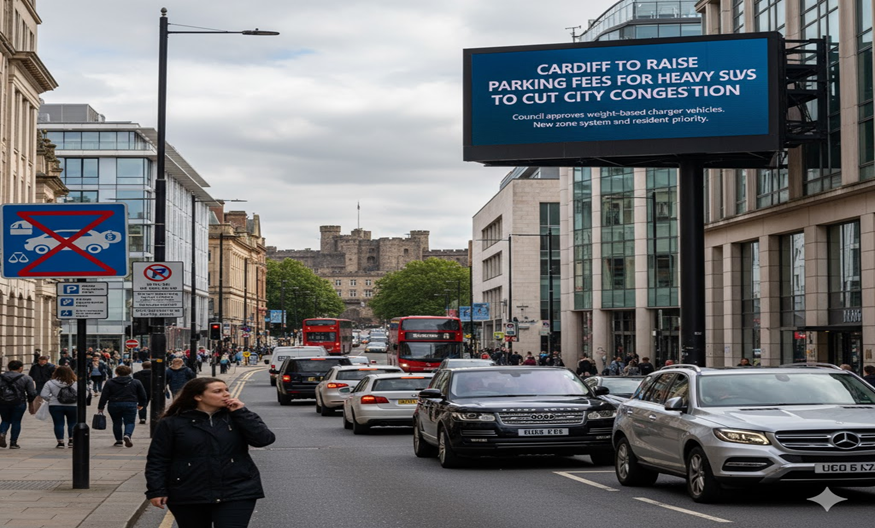

Cardiff Council approved a significant new parking scheme which directly targets owners of heavier SUVs and introduces higher charges specifically based on a vehicle’s weight. The council gave the plan the green light on October 16, forming a crucial part of a much broader strategy aimed at reducing traffic congestion and simultaneously improving air quality throughout the city.
This proactive measure will also give priority to residents in high-demand parking zones. Consequently, vehicles weighing over $2,400 \text{ kg}$, which notably include large models like the Range Rover, will be subject to a future surcharge, although officials have yet to announce exact figures.
Consequently, Cardiff will be divided into three entirely distinct parking zones under the new system: the central City & Civic zone, the Inner area, and the Outer areas. This comprehensive restructuring will allow the council to apply differentiated pricing and access rules depending entirely on the area's location and demand.
For example, in the heavily centralized "City & Civic" zone, on-street parking will be strictly limited to bona fide residents, essential Blue Badge holders, key service workers, and registered local businesses. According to council officials, this calculated move ensures that priority parking will directly go to those who genuinely need the space, limiting discretionary driving.
Furthermore, the extensive plan includes changes that now require motorcycles to obtain permits when they park in any resident bays, a rule not previously enforced. Daily and hourly visitor permits will still be available, but these permits will heavily prioritize essential carers, disabled users, and other genuinely necessary visitors. The overall council goal is to discourage unnecessary car use while simultaneously ensuring that parking access always remains available for vulnerable citizen groups.
Crucially, Councilor Dan De’Ath, the official Cabinet Member for Climate Change, Strategic Planning, and Transport, actively defended the decision during the council meeting. He explained that this new policy directly responds to increasing traffic pressure, particularly in residential areas where oversized cars often block pavements.
Thus, he quickly added that the council’s innovative approach specifically aims to “make streets safer, cleaner, and more accessible for all citizens” throughout the city. Moreover, he particularly emphasized that Cardiff must immediately align with its climate goals and directly address public health concerns linked to pollution.
The council genuinely believes that these important changes will not only reduce the number of oversized vehicles occupying the city center but will also proactively motivate many residents to finally choose more sustainable forms of transport. By financially discouraging the widespread use of high-emission, high-weight vehicles, the council ultimately hopes to actively create a fairer and greener parking system. Officials openly claim this progressive approach directly reflects a rapidly growing demand from ordinary citizens to finally make the city a far more livable place.
However, the extensive scheme has immediately drawn sharp criticism from opposition figures and residents living in rural areas. Andrew RT Davies, a Conservative Member of the Senedd, immediately branded the initiative an “SUV tax.” He firmly argued that many people living outside major urban centers significantly rely on larger vehicles simply for necessary family and work needs. According to his public statements, the council's core assumption that everyone can simply walk or cycle is entirely unrealistic, particularly across much of rural Wales.
Reform UK Wales also quickly voiced its strong opposition, officially stating that the council is improperly punishing ordinary motorists and creating unnecessary hardship. A prominent spokesperson described the measure as simply part of Labor's broader “anti-car” agenda and directly warned that such restrictive policies ultimately alienate working families.
In response, the council strongly maintains that the majority of public feedback, collected during a widespread consultation, actively supported the core idea of appropriately prioritizing residents and vigorously promoting environmental responsibility. That extensive consultation subsequently led to several essential adjustments, including the merging of the Bay and Outer zones to simplify complex permit administration and the crucial addition of more flexible visitor permits. Additionally, the entire scheme has officially redefined the specific eligibility rules for both student and business parking permits to openly ensure necessary fairness.
Although the final pricing details have not yet been formally confirmed, existing annual permits currently cost $£35$ for a first car and $£90$ for a second car. Any future substantial surcharge on heavier vehicles will be announced only after the council conducts a further thorough assessment. Until then, the council explicitly has committed to ongoing public communication to openly clarify precisely how the new weight-based charges will be calculated and effectively enforced.
Cardiff’s innovative approach could significantly influence other councils across both Wales and the wider UK as major cities confront similar challenges concerning emissions and limited urban space. If the scheme proves successful, it may well pave the way for reforms that directly link parking fees to a vehicle's specific weight. Nevertheless, with clear communication and data-backed pricing structures, Cardiff could set a crucial example in entirely rethinking urban parking management.