
Thailand has launched its highly anticipated Landbridge project. A $28 billion infrastructure initiative aimed at creating a major new shipping corridor between the Asia‑Pacific region, India, and the Middle East. Announced by Prime Minister Srettha Thavisin during an investor roadshow. This plan seeks to reduce global shipping bottlenecks by offering an alternative to the heavily trafficked Malacca Strait.
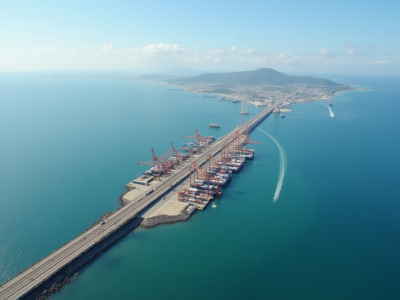
According to government briefings, the Landbridge project will involve building two deep-sea ports on opposing coasts. The western port will rise at Ranong on the Andaman Sea, while the eastern port will stand at Chumphon in the Gulf of Thailand. Importantly, these ports will connect through a dedicated network of highways and rail lines. That is creating a seamless multimodal corridor enabling faster cargo movement across Thailand’s southern peninsula.
In fact, project planners estimate that shipping travel times could fall by up to four days, while transport costs may decrease by about 15 percent. That is compared with the route through the Malacca Strait. This efficiency gain would offer significant advantages for global shippers and freight operators navigating between the Indian and Pacific Oceans. Indeed, the Malacca Strait currently handles roughly 25 percent of the world’s traded goods. Its congestion has intensified logistical pressures.
Moreover, Thailand frames the Landbridge project as a solution to rising congestion and safety concerns in existing maritime routes. For example, the narrow passage of the Malacca Strait experiences frequent traffic jams and more than 60 reported maritime accidents annually. Consequently, diversifying trade routes through the Landbridge could improve overall supply chain reliability and safety.
Economically, the Landbridge project could deliver widespread benefits for Thailand. Authorities project that the corridor will support approximately 280,000 jobs in construction, logistics, and related service sectors. That is boosting income opportunities and community development in southern provinces. Additionally, officials predict that the project could elevate Thailand’s annual economic growth rate once completed, with positive effects on national output and export competitiveness.
Thailand’s government has also moved to attract global capital by offering foreign investors. The ability to own significant stakes in joint ventures, building the Landbridge infrastructure. Already, discussions have taken place with investors from China and Saudi Arabia, and Thai officials plan to present the opportunity to U.S. investors at key economic forums. This international engagement could enhance financing prospects and promote strategic partnerships.
Strategically, the project holds significance beyond Thailand’s borders. India conducts a large volume of trade through the Malacca Strait. The Landbridge project presents a faster and more reliable export route. In particular, the corridor could reduce transport time and lower logistics costs for Indian exporters accessing Southeast Asian and Middle Eastern markets. That will strengthen regional economic ties.
In addition, the Landbridge project aligns with broader regional initiatives aimed at enhancing connectivity and trade integration across South and Southeast Asia. These efforts reflect growing recognition that efficient transport infrastructure supports economic resilience and fosters deeper cooperation among neighboring economies.
Despite its promise, the Landbridge project faces challenges. Constructing and managing large-scale infrastructure across diverse topography requires careful planning, strong governance, and significant funding. Moreover, environmental advocates and local communities have raised concerns about possible ecological disruption. This underscores the importance of robust environmental planning and mitigation measures.
Nevertheless, project backers maintain that the Landbridge initiative represents a pivotal step toward modernizing global shipping corridors. By reducing reliance on a single sea route and enhancing regional trade infrastructure, Thailand could capture long-term economic opportunities while contributing to more resilient global logistics networks.
Looking ahead, the country aims to complete significant phases of the Landbridge project by 2030. That will lead to continued collaboration between public and private stakeholders. In the process, the corridor may catalyze innovations in smart logistics, green infrastructure, and supply chain technologies. That supports sustainable growth well into the future.
In sum, the Landbridge project stands as one of Thailand’s most transformative infrastructure plans in recent memory. With its ability to speed up trade, reduce costs, create jobs, and deepen regional ties, this initiative could redefine how goods move across the Indo-Pacific region in decades to come.