
Electric vehicle sales are booming in South America without Tesla. Across the continent, Chinese carmakers are reshaping the auto market by offering affordable models and building new trade routes, while Tesla remains absent from showrooms. The shift is changing how South Americans buy cars and how they think about renewable energy.
In Peru, green energy entrepreneur Luis Zwiebach once struggled to charge his Tesla. He had imported the car himself because Tesla lacked an official presence. Today, buying an EV in Peru is far easier. Chinese brands like BYD, Geely, and Great Wall Motors sell models at nearly half the price of a Tesla. Legacy automakers such as Toyota, Kia, and Hyundai also compete, but Chinese firms dominate the conversation.
Sales figures show the trend clearly. Between January and September, Peru registered 135,394 new cars. Of those, 7,256 were hybrid or electric vehicles, a 44% jump compared to last year. While EVs remain a small segment, growth is steady. The opening of the Chinese-built Port of Chancay has accelerated imports, cutting shipping times and turning Peru into a gateway for the region.
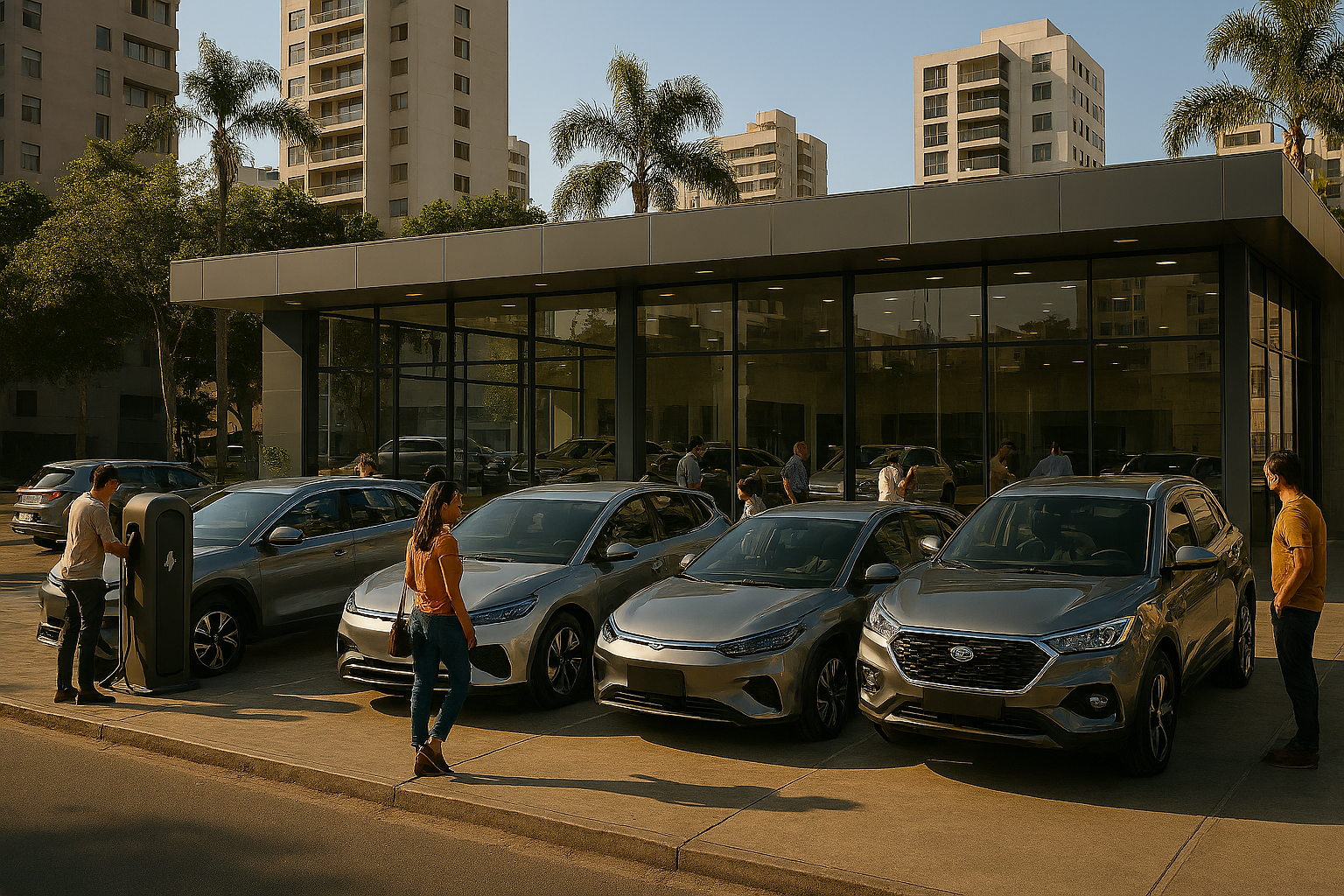
BYD plans to open more dealerships in Lima, while Chery and Geely already operate more than a dozen. Zwiebach says demand is strong, with more than two electric cars sold daily in Lima. He has expanded his renewable energy business to install chargers and solar panels for property developers, universities, and shopping centers. For many buyers, a home charger is now as essential as a parking space.
Chinese automakers are also pushing into neighboring countries. In Chile, Chinese brands captured nearly 30% of passenger car sales earlier this year. Uruguay has seen EV market share reach 28%, while Brazil recorded 9.4% in August. Even Argentina, despite economic challenges, welcomed BYD’s entry in October. The International Energy Agency reports EV penetration in Latin America doubled to 4% in 2024 and continues to rise.
Dealers say Chinese firms succeed by offering affordable models tailored to local tastes. In Uruguay, BYD has become the third-biggest seller across all vehicle types, trailing only Chevrolet and Hyundai. Prices for BYD battery electric vehicles start at $19,000, making them accessible to middle-class buyers. Local banks support sales with credit lines and promotions, further boosting demand.
The Port of Chancay illustrates China’s strategy. Once a quiet fishing town, it now handles thousands of vehicles each month. Cosco Shipping, the operator, expects 19,000 cars to arrive by year’s end. Many are trans-shipped to Chile, Ecuador, and Colombia, reinforcing Peru’s role as a distribution hub. In July alone, 3,057 cars arrived, up sharply from January’s 839.
Brazil presents a different picture. Tariff barriers encourage local production, so Chinese firms are investing in factories. BYD began assembling EVs at Ford’s former plant in Bahia, while Great Wall Motors repurposed a Mercedes-Benz facility. These moves aim to secure long-term access to South America’s largest market. Yet tensions remain, as labor groups worry about job creation and working conditions. Brazil has already reintroduced import duties, which will rise to 35% by mid-2026.
Despite challenges, Chinese automakers see Latin America as a vital outlet. At home, they face fierce competition and oversupply. Exporting cars to South America helps balance production and expand global reach. Analysts note that Chinese brands have proven they can match international standards in quality, making them credible rivals to Western manufacturers.
Consumers are responding to the shift. For Zwiebach, the appeal of EVs is simple: lower running costs and fewer trips to the garage. Charging networks remain uneven, but the convenience of plugging in at home offsets the gaps. As more buyers embrace electric cars, demand for renewable energy solutions grows alongside.
Electric vehicle sales are booming in South America without Tesla, and the trend shows no signs of slowing. With Chinese brands leading the charge, the continent is becoming a key battleground in the global auto industry. For now, Tesla’s absence leaves space for others to define the future of mobility in the region.