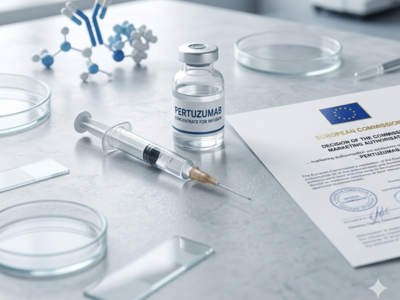

The European Commission has approved a pertuzumab biosimilar, marking a significant advancement in improving access to innovative cancer therapies across Europe. The decision grants marketing authorization to POHERDY, a pertuzumab biosimilar developed by Shanghai Henlius Biotech and commercialized globally by Organon. Moreover, this approval establishes the therapy as the first approved pertuzumab biosimilar referencing Perjeta for patients across the European Union.
The newly approved pertuzumab biosimilar is available in a 420 mg/14 mL intravenous formulation and supports all indications of the reference product. Consequently, healthcare professionals can prescribe pertuzumab-based regimens for eligible patients diagnosed with HER2-positive breast cancer across multiple treatment settings.
Breast cancer remains one of the most prevalent cancers among women in Europe, creating sustained demand for targeted biologic therapies. Therefore, the introduction of this pertuzumab biosimilar is expected to improve treatment accessibility while reducing financial pressure on healthcare systems. Pertuzumab is a monoclonal antibody that targets the HER2 receptor, which plays a crucial role in the growth of certain breast cancers. Additionally, clinicians commonly combine pertuzumab with trastuzumab and chemotherapy to deliver improved outcomes in both early-stage and metastatic disease settings.
The recommended pertuzumab biosimilar was found to be equivalent to the innovator biologic in terms of quality, safety, and efficacy through various analyses. Therefore, it was established that there are no clinically relevant differences between the efficacy and safety of the biosimilar compared with the original product. The Committee for Medicinal Products for Human Use had already given an initial positive opinion in favor of its approval as a biosimilar to pertuzumab. Subsequently, the European Commission finalized the authorization, enabling its immediate availability for integration into clinical practice across member states.
The pertuzumab biosimilar will be utilized in combination therapy approaches to treat patients with HER2-positive breast cancer in neoadjuvant, adjuvant, and metastatic cancer cases. Additionally, pertuzumab can be utilized to help address the challenges facing high-risk, locally advanced, or recurrent cancers through targeted biologic therapy. The industry's key players stressed that it was vital to increase the reach of biosimilars of pertuzumab because unmet needs exist within the field of oncology. Furthermore, an increase in the biosimilar reach could help lower costs while maintaining standards of high quality and safety.
Organon highlighted that the expansion of its portfolio within the biosimilars category indicates its commitment towards providing access to healthcare services all around the world using sustainable and affordable means. Conversely, Shanghai Henlius is still concentrated on its efforts pertaining to research and development of innovative biologic and biosimilar pipelines. The approval is consistent with an ongoing global trend towards greater uptake of biosimilars within the area of oncology and beyond. In this way, healthcare systems benefit from greater competition, leading to lower prices for medicines and improved availability of potentially lifesaving drugs.
Moreover, this same biosimilar of pertuzumab also received approval in the United States in 2025, thus ensuring that it becomes a key player in the major global markets. Therefore, the European authorization decision serves to enhance its significance as a treatment and increase its availability to patients requiring such a treatment option. The introduction of this pertuzumab biosimilar is expected to reduce overall treatment costs associated with HER2-targeted therapies across Europe. Hence, healthcare professionals will be capable of providing treatment to an increased number of patients using fewer healthcare resources more efficiently.
According to experts, biosimilars such as pertuzumab will continue to bring about change in the realm of oncology because of their availability and cost-effectiveness. Additionally, the progress made in the creation of biological products is likely to result in more approvals and broaden treatment options in the future. The European Commission remains instrumental in making sure that patients have timely access to effective medicines. This is why approvals such as the pertuzumab biosimilar emphasize the need for innovation and the promotion of equitable health services provision within the region.
The increased use of biosimilars means that cooperation among the various stakeholders in the industry will continue to play a critical role in ensuring favorable patient results. In conclusion, the approval of the biosimilar of pertuzumab is one big step towards improved cancer care service delivery in Europe.