
Google AI chips for training and inference took center stage this week as the company unveiled two new processors. In the opening announcement, Google AI chips for training and inference aim to challenge Nvidia’s dominance in AI hardware. The move shows Google’s plan to split AI workloads more efficiently. It reflects growing competition among hyperscalers. Google announced its eighth-generation tensor processing units on Wednesday. Unlike earlier designs, these chips now serve separate roles. One chip handles AI model training. Another focuses on AI inference workloads. Both processors will become available later this year.
Company executives explained that the need for more specialized chips drove the shift. As AI agents become more widespread, they require quicker responses. Using separate chips for different tasks can boost performance. Google believes this strategy will make its systems more efficient and help manage costs. The new training processor takes the place of the older mixed-use TPU design. According to Google, it offers almost three times the performance of the previous chip, while keeping the same price. These upgrades help meet the demands of large-scale AI computing.
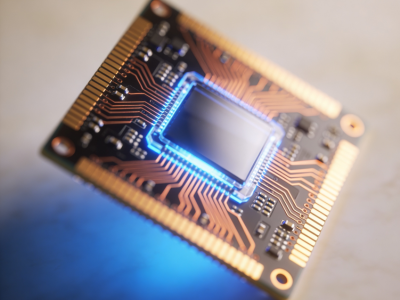
Google’s new TPU 8i chip is designed for real-time AI work. It reduces delays and increases speed. The chip has 384 megabytes of SRAM, which is three times more than the previous Ironwood TPU. SRAM is important in AI chips because it lets models get data quickly when they need to respond. Nvidia is also planning to add more SRAM to its next chips. This competition is pushing more innovation in AI semiconductors.
Google has been making its own AI chips for years, starting in 2015. By 2018, these chips became available on its cloud platform. Getting an early start helped shape the current AI chip market. While Google still relies on Nvidia, it also provides another option. Many cloud customers want choices beyond GPUs. Google’s chips work closely with its cloud AI tools, which attract businesses that want more efficient AI computing.
More industries are starting to use artificial intelligence chips. Companies are moving from general processors to specialized hardware. Big cloud providers are now making chips for specific AI tasks, which can lower costs and improve performance. Google’s latest decision highlights a growing shift toward dedicated AI accelerator chips. Businesses need reliable performance for their AI projects, and custom chips make it easier to support generative AI at scale. As more organizations use AI, their hardware decisions will shape future cloud strategies. The United States currently holds the largest share of the global market. Therefore, most early adoption occurs within American data centers.
Google’s new chips power its DeepMind infrastructure, and internal teams already rely on TPUs for research and deployment. External customers are adopting them quickly as well. For example, Citadel Securities uses TPUs for research software, and all U.S. Energy Department national labs run AI systems built on them. Anthropic has also committed to using several gigawatts of Google TPUs. These partnerships show strong confidence in the platform and help strengthen Google’s position in AI hardware.
Even with these advances, Nvidia is still the market leader. Google does not directly compare its chips to Nvidia’s. However, its decision to separate training and inference shows a clear change in strategy. Amazon and Microsoft are making similar moves. Amazon uses Trainium and Inferentia chips, while Microsoft introduced a second AI chip earlier this year. Meta is also working with Broadcom to design its own processors. All of these efforts are changing the competitive landscape in the AI infrastructure market.
Google CEO Sundar Pichai explained that the new design is meant for millions of AI agents. He pointed out that speed and quick response times are important. This level of performance helps businesses use AI across cloud services. The changes could have a big impact in the United States, where many companies depend on cloud-based AI tools. Having more chip choices might reduce costs and make these tools available to more people. It could also help the U.S. stay ahead in AI hardware.
The US leads with the highest share in the AI chip market. Consequently, new launches often focus on American users first. Google’s rollout aligns with this demand pattern. Overall, Google AI chips for training and inference represent a clear escalation in hardware competition. As AI adoption speeds up, custom silicon becomes critical. Google’s latest move signals confidence in its long-built chip expertise. The race for AI compute leadership now enters a more specialized phase.