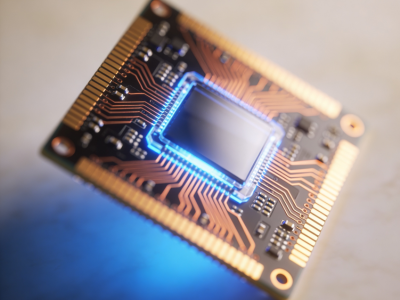

The world of artificial intelligence is growing at a speed that traditional hardware is struggling to keep up with. As AI models become more complex, the pipes that carry data between computers need to be wider, faster, and much more efficient. This is where the optical interconnect comes into play. By using light instead of electricity to move information, tech leaders are finding ways to break through old speed limits. Marvell’s recent move to acquire Polariton Technologies is a clear signal that the future of the data center isn't just digital, it is optical. This deal is about more than just buying a company; it is about securing the specialized tools needed to build the super-highways of the AI age, ensuring that data can flow without hitting a bottleneck.
Acquisition Adds Plasmonics Edge to Silicon Photonics Strategy
The Silicon Photonics Market in the United States is expanding rapidly as major cloud providers shift toward a strategy of light-speed data processing to support massive AI training clusters. This trend highlights a significant expansion where U.S. market leaders are moving away from traditional copper wiring toward silicon photonics and advanced laser-based systems to reduce heat and power consumption. By focusing on energy-efficient data transmission, domestic semiconductor firms are ensuring that AI data center infrastructure can scale to meet global demand without overloading the power grid. As the need for faster networking grows, the United States continues to lead the global landscape in both design and implementation of these complex systems. Currently, the US leads with the highest share in the Silicon Photonics market, as it serves as the primary home for the world’s most advanced hyperscale data centers and chip designers.
Marvell Moves to Strengthen Optical Leadership with Polariton Deal
By bringing Polariton Technologies into the fold, Marvell is doubling down on its mission to lead the high-speed optical networking space. Polariton is famous for its work in plasmonics technology, a specialized field that allows light to be manipulated at even smaller scales than traditional methods. This Marvell acquisition adds a massive boost to their existing portfolio, giving them the ability to create smaller, faster, and more powerful photonic integrated circuits. For a company that already powers much of the world’s data infrastructure, this move is a strategic level up. It ensures that Marvell remains the go-to partner for tech giants who need to move mountains of data in the blink of an eye.
AI Workloads Push Optical Interconnects Beyond 1.6T Limits
Not long ago, a speed of 800G or 1.6T seemed like the ultimate goal for data centers. However, the sheer intensity of modern AI workloads has changed the math. We are reaching a point where optical interconnect scaling is the only way to keep these systems from slowing down. Traditional silicon photonics has done a great job, but as we push past current limits, we need even more advanced techniques to keep data moving efficiently. Marvell’s focus on the next generation of hardware shows that they are preparing for a world where 1.6T is just the starting point. This push for higher performance is essential for everything from real-time language translation to complex scientific research that depends on massive computing power.
Race Toward 3.2T Connectivity Gains Momentum Across Data Centers
The industry is now looking squarely at 3.2T connectivity as the next big milestone. Moving data at these speeds requires a total rethink of how chips and cables interact. Data centers are evolving into scale-across architectures, where thousands of processors work as one giant machine. To make this work, the optical interconnect must be incredibly fast and consume very little power. This race toward 3.2T is gaining momentum because it is the only way to support the future of generative AI and cloud computing. Marvell’s new technology from Polariton is specifically designed to help the industry reach these speeds while keeping the hardware small enough to fit into modern server racks.
Plasmonics Emerges as a Key Enabler of High-Speed Scaling
While many people are familiar with silicon photonics, the word plasmonics technology is the new star of the show. Plasmonics allows engineers to squeeze light into tiny spaces, enabling ultra-fast modulation that traditional materials simply can't match. This is a key enabler for optical interconnect scaling because it allows for more lanes of data in the same amount of space. By using plasmonics, Marvell can build links that use much less energy per bit of data sent. This focus on energy-efficient data transmission is vital as data centers become bigger and more power-hungry. It is the technical edge that makes 3.2T and even faster speeds possible in the near future.
Integrating Photonics, DSP, and Custom Silicon into One Stack
The real strength of Marvell’s strategy is its ability to bring everything together into one stack. By combining Polariton’s plasmonics with Marvell’s world-class digital signal processors (DSP) and custom silicon, they are creating a complete solution for high-speed optical networking. This end-to-end approach is much more efficient than trying to piece together parts from different vendors. When the photonics and the processors are designed to work together perfectly, you get better performance and lower power use. This integration is exactly what next-generation data centers need to handle the unpredictable and heavy demands of the global AI economy.
Coherent and DCI Applications Drive Next-Gen Network Design
As data centers grow, the way they connect to each other, known as Data Center Interconnect or DCI optical interconnects, is becoming more important. Coherent optics allow data to travel longer distances without losing strength or speed, which is essential for connecting giant server farms across a city or region. The technology Marvell is developing will be used in ZR and ZR+ applications, which are the gold standard for long-distance, high-speed links. These DCI optical interconnects ensure that the cloud feels instant to users, no matter where they are. By improving the way these networks are designed, Marvell is making the global internet more robust and capable of handling future traffic surges.
What This Means for the Future of AI-Driven Data Infrastructure
Looking ahead, the future of AI-driven data infrastructure will be built on light. The days of relying solely on metal wires to carry high-speed signals are fading away. With the integration of plasmonics technology and photonic integrated circuits, we are entering an era of optical-first design. This means faster AI training, more responsive cloud apps, and a more sustainable way to power the world’s digital life. Marvell’s acquisition of Polariton is a major step in this journey, proving that the industry is ready to innovate at the device level to keep the AI revolution moving forward. The path to 3.2T and beyond is now clear, and it is glowing with the potential of advanced optics.