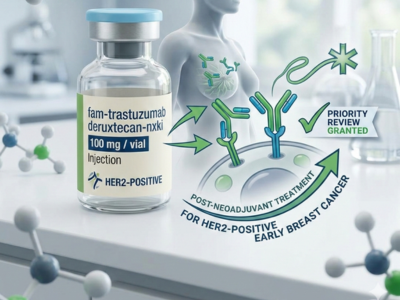

In a major development for breast cancer treatment, the U.S. Food and Drug Administration (FDA) has granted Priority Review to ENHERTU (fam‑trastuzumab deruxtecan‑nxki) as a post-neoadjuvant therapy for adult patients with HER2-positive early breast cancer, potentially reshaping care for individuals at high risk of recurrence after initial therapy.
The FDA’s decision to accelerate the regulatory review follows compelling results from the Phase III DESTINY‑Breast05 trial, which demonstrated that ENHERTU significantly reduced the risk of invasive breast cancer recurrence or death by 53% compared with trastuzumab emtansine (T‑DM1). This outcome signals a marked improvement in invasive disease-free survival (IDFS) and indicates that ENHERTU could become a new standard of care in the post-neoadjuvant setting if approved later this year.
Under the Prescription Drug User Fee Act (PDUFA), the FDA is targeting its decision by the third quarter of 2026, bringing renewed hope to clinicians and patients seeking more effective strategies to prevent recurrence after surgery. The Priority Review designation is reserved for treatments that may offer significant improvements over existing therapies for serious conditions like breast cancer.
ENHERTU’s application also received Breakthrough Therapy Designation, reflecting the FDA’s recognition of its potential to address unmet clinical needs in patients with residual invasive cancer following neoadjuvant HER2-targeted treatment. Priority Review typically shortens the review period, enabling potentially life-saving therapies to reach patients more quickly.
Approximately one in five breast cancers is classified as HER2‑positive, a subtype historically linked to aggressive disease and a greater probability of recurrence if residual invasive disease remains after initial treatment. Currently, nearly half of these patients continue to face a high risk of tumor progression even after surgery and standard post-neoadjuvant therapy, underlining the need for more effective options to sustain long‑term survival.
“The Priority Review of ENHERTU brings us closer to delivering a potentially transformative treatment option for patients with residual invasive HER2-positive early breast cancer,” said Susan Galbraith, Executive Vice President of Oncology R&D at AstraZeneca. She emphasized that despite advances in early breast cancer care, patients with residual disease after neoadjuvant therapy still face significant challenges.
Ken Takeshita, Global Head of R&D at Daiichi Sankyo, echoed these sentiments, noting that enhancing post-surgical treatment options is critical to reduce recurrence and progression to metastatic disease, where five-year survival rates decline sharply. By targeting residual disease more effectively, ENHERTU could help more patients sustain remission and possibly advance toward a curative outcome.
Data from the DESTINY‑Breast05 trial established that ENHERTU significantly boosted the three‑year invasive disease-free survival rate to 92.4%, compared with 83.7% with T‑DM1. Notably, consistent benefits were observed across different patient subgroups, including reductions in distant recurrence and brain metastasis risk, strengthening confidence in the therapy’s clinical impact.
ENHERTU’s safety profile in the trial remained consistent with what clinicians have previously observed in other settings, with no new concerns emerging. The drug’s known risks include interstitial lung disease and potential embryofetal toxicity, which healthcare providers must monitor carefully.
Beyond early breast cancer, ENHERTU already holds approvals in more than 90 countries for HER2-positive metastatic breast cancer, demonstrating its broader therapeutic value. The HR+/HER2‑ breast cancer is primarily driven by the rising prevalence of HR+/HER2‑ breast cancer, innovations in targeted therapies, and increasing awareness of early detection and screening. Regulatory submissions based on DESTINY‑Breast05 are also underway in the European Union and Japan, reflecting global momentum toward expanding access for patients with early breast cancer.
A separate supplemental application is under review in the United States for ENHERTU in combination with paclitaxel, trastuzumab, and pertuzumab (THP) in the neoadjuvant setting, potentially expanding its use earlier in the treatment course pending positive outcomes from ongoing trials.
This priority review arrives amid broader efforts to enhance outcomes for breast cancer patients worldwide, particularly those with high-risk disease profiles. Advocacy groups and clinicians alike are hopeful that FDA approval of ENHERTU will bring a paradigm shift in how residual invasive disease is managed, helping more patients achieve durable remission and improved quality of life.
If approved, ENHERTU’s expansion into post-neoadjuvant therapy could mark a significant milestone in the fight against breast cancer, underscoring the continued importance of innovation in oncology research and regulatory pathways that prioritize patient-centric advances. This forward movement builds upon recent successes in HER2-targeted therapies, highlighting the critical role of precision oncology in improving outcomes for patients with diverse subtypes of breast cancer.