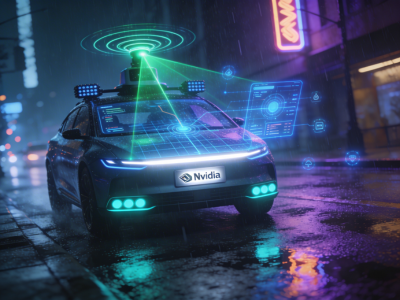

The automotive industry is entering a defining decade. Performance is no longer measured only by horsepower or design. Instead, intelligence, software, and real-time decision-making are becoming the true benchmarks of value. At the center of this shift lies Nvidia autonomous vehicle technology, which is rapidly transforming how cars are built, trained, and deployed.
What began as a graphics innovation journey has now evolved into a full-scale mobility ecosystem. Today, Nvidia is not just supplying chips. It is shaping the digital brain of next-generation vehicles. Automakers across the globe are aligning with this ecosystem to stay competitive in an increasingly AI-driven market. In this blog, we will explore how Nvidia autonomous vehicle technology is redefining global automotive strategies, accelerating the robotaxi race, and pushing manufacturers toward a software-first future.
Nvidia Autonomous Vehicle Technology Powers Partnerships
Nvidia recently secured groundbreaking partnerships with several industry titans. Giants like Hyundai, Nissan, BYD, and Geely are now integrating Nvidia’s tech. This expansion significantly broadens the global reach of the Nvidia Drive Hyperion platform. Each partner brings massive scale and regional dominance to the table. This surge in collaboration marks a major milestone for the autonomous vehicle development ecosystem. Drive Hyperion serves as the robust hardware and software backbone for the world’s most advanced cars. It offers scalable compute power designed to handle the most demanding tasks.
Core Strengths of the Hyperion Platform:
- Seamless integration for Level 4 autonomous cars.
- Safety-critical sensor fusion for accident prevention.
- Full-stack development tools for the robotaxi industry.
- Advanced driver-assistance systems (ADAS) for consumer safety.
- Data-driven continuous improvement through cloud connectivity.
This global endorsement proves that the Nvidia self-driving platform is the industry's most mature framework. It allows manufacturers to bypass years of independent research and development.
Why Nvidia Is the Go-To Partner for Future AV Programs
During the recent GTC conference, CEO Jensen Huang shared a bold vision. He described the current era as the ChatGPT moment of self-driving cars. Jensen Huang autonomous driving vision is now backed by tangible industry traction. He predicts a world where millions of vehicles are essentially robotaxi-ready upon leaving the factory. This confidence stems from Nvidia's unique, multi-layered technological stack. Unlike competitors, Nvidia offers a synchronized workflow that covers every stage of mobility.
The Three Pillars of Nvidia’s Stack:
- Data Center Training for AVs: This allows for high-fidelity driving simulation and deep reinforcement learning.
- In-Vehicle Compute: High-performance chips provide the redundancy required for Level 4 autonomous cars.
- Robotaxi Technology: Specialized software enables automakers to deploy next-generation mobility services immediately.
This training-to-deployment workflow provides a structural advantage. It far surpasses the capabilities of limited, standalone ADAS suppliers.
Global Automakers Step Up: Hyundai, BYD, and Nissan
Every new partnership reflects a distinct strategic opportunity. Hyundai's autonomous driving initiatives now align perfectly with their broader robotics goals. NVIDIA’s stack helps Hyundai scale driver-assist systems into full autonomy much faster. Meanwhile, BYD's self-driving technology is gaining massive production scale. As the world’s largest EV manufacturer, BYD’s transition is crucial. They are moving from basic assist features to full robotaxi deployments. Similarly, the Nissan AV partnership boosts their long-standing goal to commercialize robo-shuttles.
Even commercial logistics is seeing a shift. Isuzu ADAS systems powered by Nvidia target the trucking industry. Autonomous delivery fleets can dramatically increase global supply chain efficiency. Together, these partners strengthen Nvidia's position as a universal technology backbone.
The End-to-End AV Platform: A Matchless Advantage
Nvidia’s primary advantage is its unified, end-to-end platform. It brings together sensor processing, mapping, and real-time decision-making. High-fidelity simulation and safety modeling are also integrated into one package. Automakers can now significantly cut their development timelines. They can reduce system complexity while scaling across different vehicle types. This modularity is vital for meeting varied regional regulatory frameworks. Established AV developers like Aurora, Nuro, and Lucid already rely on this tech. Their success reinforces Nvidia's leadership in AI in autonomous mobility. By offering a standardized brain for the car, Nvidia levels the playing field for smaller manufacturers.
The Robotaxi Market Enters a Phase of Rapid Expansion
The robotaxi market previously faced heavy skepticism and regulatory hurdles. However, Nvidia’s recent expansion highlights a renewed global momentum. Huang anticipates an incredible number of robotaxi-ready vehicles in the coming years. The industry is currently shifting away from prototype-heavy research. We are moving toward scalable deployment built on unified platforms. While Waymo currently leads, companies like Uber and Zoox are catching up. Everyone wants a piece of the multi-trillion-dollar AV industry growth. Self-driving car technology is the key to unlocking these mobility services. Nvidia provides the reliable hardware needed to make these services a daily reality for commuters.
Why AI-Powered Self-Driving Is the Growth Catalyst
The next phase of progress depends on automotive AI systems. Hardware alone is no longer enough to solve the edge cases of driving. Nvidia’s platform taps into foundational AI breakthroughs. This allows vehicles to perceive and act with human-like judgment.
Why This Matters for the Industry:
- AI improves split-second decision-making in urban environments.
- Simulation accelerates the validation process for new safety software.
- Data centers can train massive models using millions of miles of virtual driving.
- AI eliminates the need for years of manual data labeling.
Nvidia’s model is built to evolve continuously. It learns from every mile driven on the road. This ability to learn fast and deploy even faster is fueling AV industry growth worldwide.
Global Autonomous Vehicle Market Outlook: 2026 and Beyond
Looking ahead, several trends are shaping the future of autonomous mobility. First, automakers are moving toward standardized platforms. This reduces fragmentation and improves compatibility across systems. Second, Level 4 autonomy is becoming achievable for specific use cases. Logistics, delivery fleets, and urban transport will likely lead adoption. Third, regulatory frameworks are evolving to support commercial deployment. Governments are beginning to define safety standards and liability rules. In this environment, Nvidia autonomous vehicle technology is well positioned to drive long-term growth. Its ability to combine AI, hardware, and software into a single platform gives it a strong competitive edge.
Nvidia’s Expansion Accelerates the Global Autonomy Race
Nvidia is creating a massive global network across Korea, Japan, China, and the U.S. This alignment positions Nvidia automotive partnerships as the industry standard. Drive Hyperion is now the default choice for any company seeking L4 capability. We are entering a transformative decade for the automotive sector. Nvidia autonomous vehicle technology is not just contributing to innovation. It is actively steering the competitive future of the entire global market. Automakers who delay their AI integration risk becoming obsolete. Those who embrace the Nvidia ecosystem are ready for the self-driving car future.
Final Thoughts
The automotive industry is no longer just about building cars. It is about building intelligent systems that can navigate the world safely and efficiently. Through its integrated ecosystem, Nvidia is redefining what is possible in autonomous mobility. Its technology is enabling automakers to move faster, innovate smarter, and compete on a global scale. The question is no longer whether autonomous vehicles will become mainstream. The real question is how far Nvidia's autonomous vehicle technology can push the industry, and how quickly the world is ready to follow.